Our Short List of 3
All 3 Picks at a Glance
| Product | Specs | Action |
|---|---|---|
 1. Graco Magnum ProX19 Cart Airless Paint Sprayer | Check price on Amazon | |
 2. Graco Magnum X7 Cart Airless Paint Sprayer | Check price on Amazon | |
 3. Graco Magnum X5 Stand Airless Paint Sprayer | Check price on Amazon |
Key takeaways
- Find the best airless paint sprayers for lacquer paint, with water-based and solvent-based guidance, fine-finish tips, and three solid picks.
Lacquer gives cabinets, doors, furniture, and trim a hard, smooth finish, but it is one of the least forgiving coatings to spray. The best airless paint sprayers for lacquer paint are the ones that give you fine pressure control, accept a small-orifice fine-finish tip, and match the type of lacquer in your can. That last point matters most, because water-based lacquer and solvent-based lacquer place very different demands on a sprayer.
Before you buy, check the label on your lacquer. Water-based lacquer cleans up with water and can be sprayed with a standard homeowner airless sprayer fitted with a fine-finish tip. Solvent-based lacquer is a different story: Graco states in its Magnum FAQ that standard Magnum sprayers cannot be used with solvent-based lacquers, and that only certain Pro models can spray them after a lacquer conversion kit is installed. The three sprayers below are all airless models from the same proven family, and this guide explains which lacquer each one is suited to.
What to Look For in an Airless Sprayer for Lacquer Paint
Water-based lacquer or solvent-based lacquer
Begin with the coating, not the sprayer. Read the lacquer label and the safety data sheet. If the label says water-based or waterborne and cleanup is with water, a standard airless sprayer with a fine-finish tip is a sound match. If the label says solvent-based, nitrocellulose, or catalyzed lacquer, or cleanup calls for lacquer thinner, do not assume a standard sprayer will handle it. Solvent-based lacquer can attack seals, hoses, and suction tubes that were not built for hot solvents, and it is flammable, so the sprayer must be built for it and the work area must be ventilated with ignition sources kept away. For solvent-based lacquer, the practical route in this roundup is a Graco Pro model fitted with the matching Graco lacquer conversion kit, installed exactly as Graco instructs.
Fine pressure control
Lacquer is thin and dries quickly, so the difference between a glassy coat and a runny, orange-peeled one is often a small turn of the pressure dial. Look for fully adjustable pressure rather than a few fixed settings. Lower pressure with a fine-finish tip gives a softer fan, less bounce-back, and less overspray on doors and cabinet frames. A sprayer that lets you dial pressure down smoothly is worth more for lacquer work than raw maximum pressure.
Tip size
The tip decides the finish more than any other part. Lacquer is a thin material, so it wants a small orifice, generally in the 0.010 to 0.014 inch range for fine-finish work, with a fan width matched to the piece. A 310 tip, for example, gives a 6 to 8 inch fan through a 0.010 inch orifice, which suits cabinet doors and narrow trim. The 515 tip that ships with most homeowner sprayers has a 0.015 inch orifice and a 10 inch fan, which is a wall-painting tip and is usually too much material for lacquer on a small surface. Budget for at least one fine-finish tip and the matching tip guard if your sprayer ships with a different guard system. A reversible tip lets you clear a clog by reversing it instead of stripping the gun down.
Pump, seals, and hose
An airless sprayer pushes coating through the tip at high pressure, so the pump and the fluid path must suit the material. Stainless steel piston pumps handle a wide range of coatings and hold up to regular cleaning. For solvent-based lacquer, the seals and suction tube matter most, which is why Graco sells a conversion kit that replaces those parts with solvent-resistant versions on its Pro models. A longer hose lets you keep the pump still while you move around a cabinet run, and a sprayer that supports an extension hose is handy for larger rooms.
Project size and portability
Match the sprayer to the size of the job. A stand sprayer that draws from a 1 or 5 gallon bucket suits a room or a set of cabinet doors without constant refilling. A cart sprayer suits larger interiors and repeated jobs, because the pump rolls with you. Weight matters if you carry the unit up stairs or load it into a vehicle, and a cart model trades some portability for capacity and reach.
Cleanup and storage
Lacquer dries fast inside a sprayer as well as on the surface, so cleanup is part of the purchase decision, not an afterthought. Look for a sprayer with a PowerFlush adapter and an easy-to-reach drain valve. After water-based lacquer, flush with water until it runs clear. After solvent-based coatings, flush with the solvent the coating manufacturer specifies, following the sprayer manual. Store the pump with the storage fluid the manufacturer recommends so the seals stay wet and the pump primes easily next time.
The Best Airless Paint Sprayers for Lacquer Paint
The three sprayers below are all electric airless models with stainless steel piston pumps, fully adjustable pressure, and reversible tips. They differ in capacity, reach, and lacquer compatibility, so the right one depends on whether your lacquer is water-based or solvent-based and on the size of your projects.
1. Graco Magnum ProX19 Cart Airless Paint Sprayer
View on Amazon: https://www.amazon.com/dp/B01G8SXNNS
The Graco Magnum ProX19 Cart, model 17G180, is the strongest lacquer pick in this roundup because it is the only one of the three with a manufacturer conversion path for solvent-based lacquer. Graco states that ProX19 models can spray lacquers and other solvent-based flammable materials once the matching lacquer conversion kit is installed, with the seals, suction tube, and drain valve replaced by solvent-resistant parts. The kit is a separate purchase, and the conversion must be done exactly as Graco instructs.
For water-based lacquer it works straight out of the box with a fine-finish tip fitted. The ProX19 delivers up to 0.38 gallons per minute at a maximum pressure of 3000 PSI, with a maximum tip size of 0.019 inch, so it has the flow to keep up with large panels and the control to lay down a thin lacquer coat when the pressure is dialed down. It comes with an SG3 metal spray gun with a built-in swivel, a RAC IV 515 SwitchTip, a 50 foot Duraflex paint hose, Pump Armor storage fluid, and a PowerFlush adapter. The hose can be extended up to 150 feet, and the DC motor supports up to 150 feet of extension cord. The cart rolls with you, the suction tube draws directly from a 1 or 5 gallon bucket, and the ProXChange pump system lets you replace the pump on the job with no tools. Graco lists this model for projects up to 30 gallons, at 42 pounds, with a one year warranty against manufacturer defect.
Who it suits: Homeowners, remodelers, and property maintenance users who spray lacquer regularly, especially anyone working with solvent-based lacquer who is willing to fit the conversion kit, and anyone painting large interiors where the cart and the long hose earn their keep.
Considerations: It is the heaviest sprayer here, so it needs floor space and a vehicle that can take a cart unit. The 515 tip in the box is a wall-painting tip, so a fine-finish tip is an essential extra for lacquer. The lacquer conversion kit is a separate purchase, and solvent-based lacquer demands strict ventilation, grounding, and cleanup discipline.
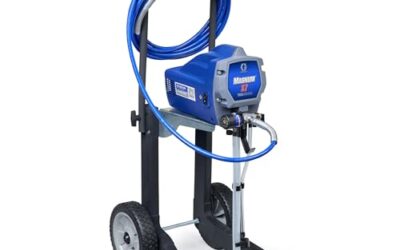
2. Graco Magnum X7 Cart Airless Paint Sprayer
View on Amazon: https://www.amazon.com/dp/B0026SSW8G
The Graco Magnum X7 Cart, model 262805, is the mid-capacity pick for water-based lacquer on larger projects. It delivers up to 0.31 gallons per minute at a maximum pressure of 3000 PSI, with a maximum tip size of 0.017 inch and fully adjustable pressure control. The stainless steel piston pump sprays unthinned coatings straight from a 1 or 5 gallon bucket through the flexible suction tube, and the cart makes it easy to move the pump around a room without carrying the unit.
For lacquer work, the X7 earns its place on water-based lacquer only. Graco states that standard Magnum sprayers cannot be used with solvent-based lacquers, and there is no lacquer conversion kit for the X7, so it should not be used for solvent-based or nitrocellulose lacquer. With a water-based lacquer and a fine-finish tip in the 0.010 to 0.014 inch range, the X7 lays down a smooth coat on cabinet doors, interior doors, and trim.
It ships with an SG2 metal spray gun, a RAC IV 515 SwitchTip, a 25 foot Duraflex paint hose, Pump Armor storage fluid, and a PowerFlush adapter, and it supports up to 100 feet of hose for second stories and long runs. Graco lists it for projects up to 15 gallons, at about 26 pounds, with a one year warranty against manufacturer defect.
Who it suits: Homeowners tackling a whole room, a set of interior doors, or a run of cabinets with water-based lacquer, and anyone who wants a cart sprayer with more capacity than the X5 without stepping up to a Pro model.
Considerations: It is not suitable for solvent-based lacquer, and there is no conversion kit for this model. The included 515 tip is too large for fine lacquer work, so a fine-finish tip is needed.
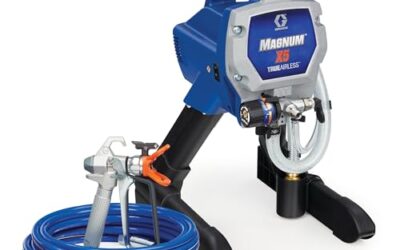
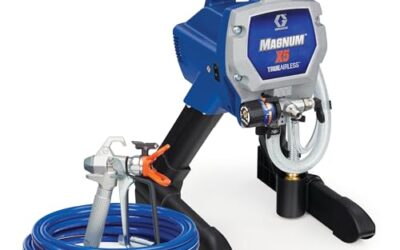
3. Graco Magnum X5 Stand Airless Paint Sprayer
View on Amazon: https://www.amazon.com/dp/B0026SR0FW
The Graco Magnum X5 Stand, model 262800, is the compact pick for water-based lacquer on small to midsize jobs. It delivers up to 0.27 gallons per minute at a maximum pressure of 3000 PSI, with a maximum tip size of 0.015 inch and fully adjustable pressure control. The stainless steel piston pump draws directly from a 1 or 5 gallon bucket through a flexible suction tube, so there is no cup to refill between cabinet doors. For lacquer, the same boundary applies as with the X7: the X5 is for water-based lacquer only. Graco states that standard Magnum sprayers cannot be used with solvent-based lacquers, and no lacquer conversion kit is available for the X5. Used within that boundary, with a fine-finish tip fitted, the X5 is a capable machine for cabinet doors, furniture, trim, and small rooms. Its lower flow is an advantage on lacquer, since it is easier to keep the coat thin and even.
It ships with an SG2 metal spray gun, a RAC IV 515 SwitchTip, a 25 foot Duraflex paint hose, Pump Armor storage fluid, and a PowerFlush adapter, and it supports up to 75 feet of hose. Graco lists it for projects up to 10 gallons, at 17 pounds, with a one year warranty against manufacturer defect.
Who it suits: Homeowners and DIYers spraying water-based lacquer on cabinets, furniture, doors, and trim a few times a year, and anyone who wants the smallest, lightest airless sprayer that still draws from a bucket.
Considerations: It is not suitable for solvent-based lacquer. The included 515 tip is a wall-painting tip, so a fine-finish tip is essential for lacquer, and the 10 gallon project size makes it a poor fit for very large jobs.
Airless Paint Sprayers for Lacquer Paint Compared
| Sprayer | Max pressure | Flow | Max tip size | Hose included | Max hose length | Lacquer fit |
|---|---|---|---|---|---|---|
| Graco Magnum ProX19 Cart | 3000 PSI | 0.38 GPM | 0.019 in | 50 ft | 150 ft | Water-based lacquer; solvent-based lacquer with Graco conversion kit fitted |
| Graco Magnum X7 Cart | 3000 PSI | 0.31 GPM | 0.017 in | 25 ft | 100 ft | Water-based lacquer only |
| Graco Magnum X5 Stand | 3000 PSI | 0.27 GPM | 0.015 in | 25 ft | 75 ft | Water-based lacquer only |
Choosing for Your Use Case
If you spray solvent-based lacquer, the choice is straightforward: the ProX19 with the matching Graco lacquer conversion kit is the only pick here with a manufacturer-supported path. Confirm the correct kit for your exact model number with Graco before ordering, and fit it exactly as instructed. Do not improvise with seals or hoses from another sprayer, and do not use a standard Magnum sprayer for solvent-based lacquer.
If you spray water-based lacquer, choose by project size. For a single cabinet run, a few doors, or a piece of furniture, the X5 gives you everything you need in the lightest package, and its lower flow makes thin coats easier to control. For a whole kitchen or several rooms, the X7 adds flow, hose reach, and a cart. For frequent work or large interiors, the ProX19 adds the highest flow, the longest hose, the swivel gun, and the tool-free pump change, and it keeps the solvent-based option open.
Tip choice matters as much as the sprayer. For lacquer, begin with a fine-finish tip in the 0.010 to 0.014 inch range and a fan width that matches the piece: a narrow fan for face frames and stiles, a wider fan for flat door panels. Spray a sample board first, adjust the pressure until the fan is even edge to edge, and keep the gun moving at a steady distance, usually around 12 inches from the surface. Thin coats beat one heavy coat with lacquer, since a heavy coat runs and sags.
Ventilation and protection matter too. Lacquer fumes are strong even in water-based formulas, so ventilate the room and wear gloves, eye protection, and a respirator designed for organic vapors when the coating calls for it. Keep solvent-based lacquer away from ignition sources and never spray it in a closed room.
Care and Use After Spraying Lacquer
Cleanup decides how long an airless sprayer lasts, and lacquer punishes a skipped flush more than latex does. As soon as you finish spraying, relieve the pressure, remove the tip and guard, and flush the system. For water-based lacquer, flush with clean water until the fluid runs clear, then run the storage fluid through the pump as the manual directs. For solvent-based coatings on a converted Pro model, flush with the solvent the coating manufacturer specifies.
Clean the tip and gun filter separately, and inspect the tip for wear. A worn tip sprays a wider, uneven fan and puts down more material than the size suggests, which shows up as runs and a rough finish on lacquer. Keep a spare fine-finish tip on hand. Store the sprayer with Pump Armor or the storage fluid Graco recommends, and keep the unit somewhere dry and out of freezing temperatures.
Between coats, scuff-sand lightly with fine grit paper and remove the dust before the next pass. Lacquer melts into the previous coat, so light sanding is about removing dust nibs and raised grain. Keep the work area clean, since airborne dust lands in a wet lacquer coat and stays there. If the finish looks rough, the cause is usually a worn tip, pressure set too high, the gun held too far away, or dust in the air, so check those four things before changing anything else.
Frequently Asked Questions
Can I spray solvent-based lacquer with a Graco Magnum X5 or X7?
No. Graco states that standard Magnum sprayers cannot be used with solvent-based lacquers. The X5 and X7 are suited to water-based lacquer with a fine-finish tip. For solvent-based lacquer, use a Pro model such as the ProX19 fitted with the matching Graco lacquer conversion kit, installed exactly as Graco instructs.
What tip size should I use for lacquer?
Lacquer is thin, so it wants a small orifice, generally 0.010 to 0.014 inch for fine-finish work, with the fan width matched to the piece. A 310 tip gives a 6 to 8 inch fan through a 0.010 inch orifice and suits cabinet doors and trim. The 515 tip that ships with these sprayers is a wall-painting tip and is usually too large for lacquer on small surfaces.
Is an airless sprayer better than a brush for lacquer?
An airless sprayer lays down a faster, more even coat with no brush marks, which suits large flat surfaces such as cabinet doors and panels. A brush still has a place for tiny touch-ups and tight corners. The sprayer also needs masking, ventilation, and a thorough flush afterward, so it earns its keep on larger jobs.
Do I need to thin lacquer for an airless sprayer?
Most lacquers do not need thinning when the tip and pressure match the material. Always check the lacquer label first: if the manufacturer specifies a thinner or a reduction, follow that exactly.
How do I clean an airless sprayer after spraying lacquer?
Relieve the pressure first, then flush the system right away: water for water-based lacquer, the specified solvent for solvent-based coatings. Clean the tip and gun filter separately, inspect the tip for wear, and store the pump with the recommended storage fluid.
Conclusion
The best airless paint sprayers for lacquer paint begin with an honest match between the sprayer and the lacquer in the can. For water-based lacquer, the Graco Magnum X5 suits small jobs, the X7 suits larger rooms, and the ProX19 suits frequent, large-scale work. For solvent-based lacquer, the ProX19 with Graco’s lacquer conversion kit is the pick with a manufacturer-supported route. Fit a fine-finish tip, test thin coats on a sample board, and flush the sprayer when you finish.
Disclosure: As an Amazon Associate, we earn from qualifying purchases.