Key takeaways
- Compare air compressors for LVLP spray guns by CFM at working pressure, tank size and noise, from a 20-gallon shop machine to compact portable picks.
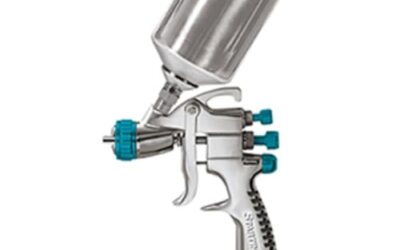
An LVLP spray gun is forgiving about pressure and demanding about volume. The gun itself sips air at low pressure compared with a conventional spray gun, but it still drinks steadily for as long as the trigger is pulled, and the moment the compressor falls behind, the fan pattern narrows, the finish turns dry and orange peel follows. Picking the right compressor for LVLP work is therefore less about headline pressure and more about delivered airflow at the pressure the gun actually uses, plus enough tank to smooth out the pump’s work.


This guide lines up five compressors that can genuinely feed an LVLP gun, from a 20-gallon shop machine for full panels to compact high-pressure portables for smaller work. Each one is a real air compressor with published delivery figures, and the differences that matter are airflow at working pressure, tank capacity, pump type and noise.
As an Amazon Associate, we earn from qualifying purchases.
Quick Picks
Our Short List of 3
- Best for: Long spray runs and full panels in a home shop
- Tank 20 gallons, steel; 6.40 CFM at 40 PSI; 5.30 CFM at 90 PSI; maximum pressure 125 PSI; 2.0 HP oil-free dual piston pump; noise level 70 dB; wheel kit fitted
- Best for: The highest airflow in a portable frame, and heavy regular use
- Tank 5.2 gallons; 6.9 CFM at 40 PSI; 6.5 CFM at 90 PSI; maximum pressure 140 PSI; 3.0 HP oil-lubricated cast iron pump; 13.8 amps; roll cage with wheels and folding handle

- Best for: Quiet all-round LVLP work in a garage
- Tank 10 gallons, steel; 6.40 CFM at 40 PSI; 5.30 CFM at 90 PSI; 2.0 HP oil-free dual piston pump; noise level 70 dB; wheel kit fitted
All 5 Picks at a Glance
| Product | Specs | Action |
|---|---|---|
| California Air Tools 20020 |
| Check price on Amazon |
| Makita MAC5200 |
| Check price on Amazon |
| California Air Tools 10020C |
| Check price on Amazon |
 DEWALT D55146 |
| Check price on Amazon |
 Metabo HPT EC914S (The Tank) |
| Check price on Amazon |
How to Choose
Match CFM at the gun’s working pressure, not the headline figure. LVLP stands for Low Volume Low Pressure: the gun regulates tank air down to a low working pressure at the cap, so the compressor figure that matters most is delivery at lower pressure, usually published as CFM at 40 PSI, backed up by the CFM at 90 PSI figure. Read your gun’s manual for its air consumption, then choose a compressor whose published delivery at 40 PSI clears that number with room to spare. A compressor that only just matches the gun on paper will run almost nonstop while you spray, heat up and wear faster.
Tank size decides how the work feels. The tank is a buffer between you and the pump. A 20-gallon tank lets you spray a long panel in one rhythm while the pump cycles occasionally in the background. A 5- or 6-gallon tank on a strong pump can keep up on airflow but will cycle far more often, and every cycle is a chance for pressure at the gun to sag mid-pass. For furniture, cabinets and single panels, a mid-size tank on a high-flow pump works well. For car panels, doors and anything you spray in long continuous passes, favour the biggest tank you have room for.
Noise is a real specification in a home shop. Compressors publish noise in decibels, and the gap between a quiet-series machine at 70 dB and a conventional jobsite unit is the gap between holding a conversation nearby and leaving the room. Low-RPM oil-free pumps in the quiet class are built for indoor and attached-garage use. Traditional high-RPM pumps deliver strong airflow but are loud enough that most people park them behind a door or wear hearing protection.
Oil-free versus oil-lubricated pumps. Oil-free pumps need no oil changes and cannot push oil mist toward the gun, which suits spraying. Oil-lubricated cast iron pumps, like the Makita in this guide, are the durability choice for heavy daily use, but they ask for oil checks and changes, and any spray setup still needs a filter and water separator between tank and gun. Whichever pump you choose, plan on a regulator and a moisture trap at the gun: tank air carries condensed water, and water in the line ruins a finish faster than a slightly small compressor does.
Check the electrical draw. The stronger portables in this guide draw close to a full household circuit’s capacity. Run the compressor on its own circuit where you can, avoid long thin extension cords, and remember that a compressor sharing a circuit with shop lights and a dust collector will trip breakers at the worst moment.
Best Options
California Air Tools 20020
- Best for: Long spray runs and full panels in a home shop
- Tank 20 gallons, steel; 6.40 CFM at 40 PSI; 5.30 CFM at 90 PSI; maximum pressure 125 PSI; 2.0 HP oil-free dual piston pump; noise level 70 dB; wheel kit fitted
Long spray runs and full panels in a home shop
It is the largest and heaviest machine here, and the pump is shared with the 10-gallon model below, so what you are paying for is storage, not extra flow
The 20020 is the shop anchor of this lineup: a 20-gallon steel tank on wheels, fed by the same 2.0 HP oil-free dual piston pump California Air Tools fits to its smaller quiet models. It delivers 6.40 CFM at 40 PSI and 5.30 CFM at 90 PSI, which clears the appetite of a full-size LVLP gun at working pressure, and the big tank means the pump tops up in the background instead of chasing the trigger. For spraying doors, car panels or a run of cabinet boxes, that combination of flow and storage is what keeps pressure steady from the first pass to the last.
At 70 dB it is also civilised enough for an attached garage. The trade is size and weight: this is a machine that rolls around a shop, not one you carry up stairs or load into a car boot for site work.
Watch out for: It is the largest and heaviest machine here, and the pump is shared with the 10-gallon model below, so what you are paying for is storage, not extra flow
Makita MAC5200
- Best for: The highest airflow in a portable frame, and heavy regular use
- Tank 5.2 gallons; 6.9 CFM at 40 PSI; 6.5 CFM at 90 PSI; maximum pressure 140 PSI; 3.0 HP oil-lubricated cast iron pump; 13.8 amps; roll cage with wheels and folding handle
The highest airflow in a portable frame, and heavy regular use
Loud in operation, needs oil maintenance, and the small tank means the pump cycles often even though it keeps up
The MAC5200 is the airflow heavyweight of the group. Its oil-lubricated Big Bore cast iron pump delivers 6.9 CFM at 40 PSI and 6.5 CFM at 90 PSI, the strongest figures in this guide, so it holds pressure under an LVLP gun with the least effort. The tank is only 5.2 gallons, which sounds small next to the 20-gallon machine above, but the pump recovers so quickly that the pairing works: the tank smooths the delivery and the pump rarely falls behind. A roll cage, wheels and a folding handle make it a genuinely portable industrial unit.
The compromises are noise and upkeep. This is a conventional high-RPM oil-lubricated machine, markedly louder than the quiet-series models, and it needs oil checks, oil changes and respect for the maker’s limit on pumping time per hour. In return you get the pump most likely to survive years of daily work.
Watch out for: Loud in operation, needs oil maintenance, and the small tank means the pump cycles often even though it keeps up
California Air Tools 10020C
- Best for: Quiet all-round LVLP work in a garage
- Tank 10 gallons, steel; 6.40 CFM at 40 PSI; 5.30 CFM at 90 PSI; 2.0 HP oil-free dual piston pump; noise level 70 dB; wheel kit fitted
Quiet all-round LVLP work in a garage
On very long continuous passes the 10-gallon tank will cycle the pump more than the 20-gallon model, and the oil-free pump is built for hobby and light trade duty rather than all-day production
The 10020C is the balanced pick for most home LVLP work. It uses the same 2.0 HP oil-free dual piston pump as the 20020, delivering 6.40 CFM at 40 PSI and 5.30 CFM at 90 PSI, but wraps it around a 10-gallon steel tank on wheels. That is enough storage for furniture, cabinets, trim and single panels sprayed at a normal pace, in a machine that still moves around a garage easily and runs at a 70 dB noise level you can live with indoors.
Choose it over the 20020 when your spraying comes in shorter sessions and floor space matters. Choose the 20020 instead when you spray large panels end to end and want the pump cycling as little as possible.
Watch out for: On very long continuous passes the 10-gallon tank will cycle the pump more than the 20-gallon model, and the oil-free pump is built for hobby and light trade duty rather than all-day production
DEWALT D55146
- Best for: Small footprint with deep air storage for shorter spray sessions
- Tank 4.5 gallons; 5.0 SCFM at 90 PSI; maximum tank pressure 225 PSI per the listing; 1.6 HP motor; oil-free pump; 15 amps; wheels and collapsible handle
Small footprint with deep air storage for shorter spray sessions
The small tank is a buffer, not a reservoir — full car panels will have the pump running almost continuously, and the 15-amp draw is unfriendly to shared circuits
The D55146 takes a different route to the same problem: instead of a big tank, it charges a small 4.5-gallon tank to a much higher pressure. The listing rates the tank at 225 PSI maximum and the pump at 5.0 SCFM at 90 PSI, so the little tank holds more usable air above the gun’s working pressure than its size suggests, and recovery is quick. For LVLP work in shorter bursts — a cabinet door, a fender, a set of shelves — it delivers strong, steady air from a compact wheeled unit with a collapsible handle.
The build is jobsite-grade DEWALT, with an oil-free pump and a high-flow coupler. The limits are the flip side of the design: on a long panel the small tank empties its buffer quickly and the pump runs hard to keep pace, and at 15 amps it wants a healthy circuit to itself.
Watch out for: The small tank is a buffer, not a reservoir — full car panels will have the pump running almost continuously, and the 15-amp draw is unfriendly to shared circuits
Metabo HPT EC914S (The Tank)
- Best for: Compact compressor for smaller LVLP jobs and detail guns
- Tank 6 gallons, pancake; 4.0 CFM at 90 PSI; maximum pressure 200 PSI; oil-free pump; model EC914S
Compact compressor for smaller LVLP jobs and detail guns
The lowest airflow here — pair it with a detail or mini LVLP gun and modest panels, not a full-size gun on car bodywork
The EC914S, sold as The Tank, is the compact option that still respects LVLP air demand. Its 6-gallon pancake tank charges to 200 PSI, well above the 150 PSI class norm, and the pump delivers 4.0 CFM at 90 PSI — the lowest figure in this guide, but from a listing-verified rating rather than an inflated one, and the high storage pressure stretches each fill. It suits a detail or mini LVLP gun, small panels, touch-up work and shops where the compressor also has to earn its keep running nailers.
Be honest about the ceiling: a full-size LVLP gun spraying a large panel will out-breathe this machine. For small work it is light, simple and oil-free, and the pancake shape stores neatly under a bench.
Watch out for: The lowest airflow here — pair it with a detail or mini LVLP gun and modest panels, not a full-size gun on car bodywork
Which One Fits
Spraying full panels, doors or a vehicle in a home shop points to the California Air Tools 20020: the 20-gallon tank and 5.30 CFM at 90 PSI keep pressure boringly steady, and 70 dB keeps the garage usable. If the compressor will also serve daily trade work and you value pump life over quiet, the Makita MAC5200 has the strongest airflow in the guide and a cast iron pump built for it, at the cost of noise and oil upkeep.
For typical garage LVLP work — furniture, cabinets, trim, one panel at a time — the California Air Tools 10020C is the sweet spot of flow, storage and noise. Short on space but spraying in shorter sessions? The DEWALT D55146 stores its air at high pressure so a 4.5-gallon tank behaves bigger than it is. Running a detail gun and small work, or splitting time with nailers, is the Metabo HPT EC914S brief.
Common Mistakes
Buying on maximum PSI alone. A 200 PSI badge says nothing about airflow. A compressor lives or dies for spraying on its CFM delivery at the pressure the gun uses, so compare the at-40-PSI and at-90-PSI figures first and the pressure headline last.
Matching the gun’s CFM exactly. If the gun’s stated consumption equals the compressor’s stated delivery, the pump runs without rest and pressure still sags on long passes. Leave clear headroom between the two numbers.
Ignoring the tank. Two compressors with the same pump behave differently on 5 gallons and 20 gallons. Small tanks are fine for detail work and frustrating on panels; buy the tank for the largest job you actually spray.
Skipping the water separator. Compressor tanks condense water, and an LVLP gun will spray that water straight into your finish. A regulator with a moisture trap near the gun is not an accessory, it is part of the setup.
Running a big compressor on a weak circuit. The stronger machines here draw 13.8 to 15 amps. Shared circuits and long extension cords cause slow fills, hot motors and tripped breakers mid-panel.
FAQ
How much CFM does an LVLP spray gun need?
It depends on the gun: mini and detail LVLP guns sip air, while full-size LVLP guns are thirstier. Read the consumption figure in your gun’s manual, then pick a compressor whose published delivery at 40 PSI beats it with headroom. Every machine in this guide publishes its at-40-PSI or at-90-PSI delivery so you can compare directly.
Is a 6-gallon compressor enough for LVLP spraying?
For a detail gun, touch-ups and small panels, yes — especially a high-pressure model like the EC914S that stores air at 200 PSI. For full-size guns and long panels, a 6-gallon tank cycles constantly and pressure control suffers; step up to 10 or 20 gallons.
Do I need an oil-free compressor for spraying paint?
Not strictly, but it removes one contamination path and all oil maintenance. An oil-lubricated machine like the MAC5200 sprays perfectly well through a filter and water separator, which any setup should have anyway. Choose based on duty and noise, then filter the air either way.
Why does my pressure drop while I am spraying?
The gun is using air faster than the pump replaces it, so the tank drains toward the gun’s working pressure. The fixes are a compressor with more delivery at working pressure, a larger tank to buffer the pass, or shorter passes with pauses — in that order of expense.
Final Verdict
For most people spraying with an LVLP gun at home, the California Air Tools 10020C is the right default: real airflow at working pressure, a 10-gallon buffer and a noise level that suits a garage. Step up to the 20020 for long panels and longer sessions, take the Makita MAC5200 when maximum airflow and pump durability outrank quiet, and let the DEWALT D55146 or Metabo HPT EC914S cover the compact end of the bench. Match the CFM first, the tank second and the badge last, and an LVLP gun becomes the low-overspray pleasure it is meant to be.