Our Short List of 3
All 3 Picks at a Glance
| Product | Specs | Action |
|---|---|---|
 1. OPTIMA RedTop 34/78 — best overall for most 1998 Cherokees | Check price on Amazon | |
 2. OPTIMA RedTop 34 — the straightforward stock replacement | Check price on Amazon | |
 4. MARXON Group 34 AGM — the value pick | Check price on Amazon |
Key takeaways
- Find the best battery for a 1998 Jeep Cherokee XJ: four Group 34 AGM picks compared by CCA, reserve capacity, terminals and fitment for the 2.5L and 4.0L.
As an Amazon Associate we earn from qualifying purchases.
Affiliate Disclosure: This article contains affiliate links. If you buy through a link on this page, we may earn a commission at no extra cost to you. We only list batteries that match the fitment described below, and all specifications come from the manufacturer or the product listing.
The short answer
The 1998 Jeep Cherokee, the XJ generation, takes a BCI Group 34 battery. Fitment guides for the 1997 to 2001 Cherokee list Group 34 for both engines offered that year, the 2.5-liter four-cylinder and the 4.0-liter inline-six, with a factory minimum in the region of 600 cold cranking amps. Every battery in this guide is a Group 34 or Group 34/78 case, is 12-volt, uses top posts the XJ cables can reach, and clears that minimum cranking figure with room to spare.
That single fact rules out a long list of batteries that show up in generic searches. Group 65 batteries fit later Cherokees from 2000 in some listings and fit many Grand Cherokees, but they are longer and taller than the XJ tray was designed around. Group 58 was the stock size on earlier XJs, and a Group 58 will physically sit in a 1998 truck, but it gives up a large amount of cranking power and reserve capacity compared with the Group 34 the later tray accepts. If a listing does not say Group 34, 34/78, D34, or D34/78, it is not a pick for this vehicle, however strong its numbers look.
All four picks below are absorbed glass mat, or AGM, batteries. That matters on an XJ for three practical reasons. AGM cases are sealed, so there is no electrolyte to spill on rough roads or steep climbs. They tolerate vibration far better than a conventional flooded battery, which suits a solid-axle Jeep that spends time on washboard tracks. And they recharge faster and hold charge better in storage, which helps a vehicle that many owners now keep as a second or weekend truck rather than a daily driver.
Quick comparison
| Pick | Best for | Group size | CCA | Reserve capacity | Terminals |
|---|---|---|---|---|---|
| OPTIMA RedTop 34/78 | Strongest all-round starting | 34/78 | 800 | 100 minutes | Dual SAE top and GM side |
| OPTIMA RedTop 34 | Pure starting, stock layout | 34 | 800 | 100 minutes | SAE top post |
| OPTIMA YellowTop D34/78 | Winches and accessories | D34/78 | 750 | 120 minutes | Dual SAE top and GM side |
| MARXON Group 34 AGM | Value Group 34 replacement | 34 | 650 | Not stated in the same format | A1 top post |
Figures are taken from the manufacturer and listing data for each model. Always confirm the group size and terminal position against the battery currently in your Cherokee before ordering, because a previous owner may have changed cables or the tray.
1. OPTIMA RedTop 34/78 — best overall for most 1998 Cherokees
The RedTop 34/78 is the battery most XJ owners should start with. It is a sealed AGM starting battery rated at 800 cold cranking amps, well above the roughly 600 CCA minimum listed for the 1998 Cherokee, in a case that measures about 10 by 6-7/8 by 7-13/16 inches. That is the Group 34 footprint, with the added 78 side-terminal provision in the same case.
The dual terminals are the practical advantage here. A stock 1998 Cherokee uses top-post cables, and the RedTop 34/78 has standard SAE top posts in the correct layout. The additional GM-style side terminals give you a clean, fused connection point for accessories such as auxiliary lights, a small inverter, or a ham radio without stacking ring terminals under the main clamp. On a vehicle where owners routinely add electrical gear, that is a real benefit rather than a marketing extra.
OPTIMA builds this battery around its SpiralCell design, with wound cells rather than flat plates, and the manufacturer rates it at up to 15 times the vibration resistance of a standard flooded battery and up to three times the life in comparable use. Those are manufacturer claims, not results from our own testing, and we present them as such. What can be said without qualification is that a sealed AGM with that construction is a sensible match for a unibody Jeep that transmits a lot of road shock into the engine bay.
Reserve capacity is listed at 100 minutes, which is enough to run lights and essential electrics for a useful period if the alternator fails away from home, and to cover the short, repeated starts that come with trail use and winter mornings. The battery weighs about 38.8 pounds according to the listing, which is manageable for a one-person swap with the hood open and the hold-down removed.
Choose the RedTop 34/78 if your Cherokee is mainly a road and light-trail vehicle, if cold starts are your main concern, or if you want one battery that covers the stock cables today and accessory wiring tomorrow. Skip it if you regularly deep-cycle the battery with a winch or a fridge, because a starting battery is not designed for repeated deep discharge. That job belongs to the YellowTop below.
2. OPTIMA RedTop 34 — the straightforward stock replacement
The RedTop 34 is the same starting-battery idea in a simpler case: Group 34 only, standard SAE top posts only, and the same headline 800 cold cranking amps. The manufacturer part number for this model is 8002-002. If your 1998 Cherokee is completely stock electrically, this is the cleanest replacement in the guide, because there is nothing extra to clear the hood, clear the hold-down, or confuse the next person who works on the truck.
Cranking performance is the point of both RedTops. The 4.0-liter six is not a high-compression engine, but it is a long-crank engine when fuel pressure has bled down, when oil is thick on a cold morning, or when the starter itself is old and drawing more current than it once did. An 800 CCA rating gives margin in all three cases, and margin is what turns a marginal no-start into an ordinary start. The 2.5-liter four benefits in the same way, with even more headroom relative to its smaller displacement.
Like the 34/78, the RedTop 34 is a sealed, maintenance-free AGM that can be mounted in many positions, resists vibration, and recharges faster than a conventional flooded battery. There are no caps to check and no water to top up, which suits an engine bay that on many surviving XJs is checked less often than it should be.
The trade-off against the 34/78 is flexibility. You lose the side terminals, so accessories have to share the top posts or run from a separate distribution block, which is arguably the tidier solution anyway. You also need to be certain about terminal position before ordering any Group 34 battery: a reversed-layout variant, sold as 34R in some ranges, puts the positive post on the opposite side and can leave stock XJ cables too short. The standard RedTop 34 listed here is the conventional layout; still, compare the post positions with the battery coming out of your Jeep, not just with a diagram.
Choose this battery if you want maximum starting power in the exact stock format and nothing more. It is the pick for a daily-driven 1998 Cherokee, a restoration that should stay close to original, or any XJ whose accessory loads are modest.
3. OPTIMA YellowTop D34/78 — best for winches, lights and fridges
ASIN: B000MSBUA4
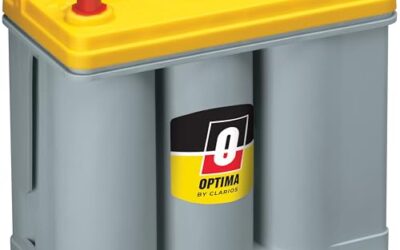
The YellowTop D34/78 is a dual-purpose AGM battery: it is built both to start the engine and to tolerate the deeper, repeated discharge that accessories impose. It is rated at 750 cold cranking amps, a little below the RedTops, but its reserve capacity rises to 120 minutes and its cycle tolerance is the reason to buy it. The manufacturer part number is 8014-045, and the case is the same dual-terminal Group 34/78 format, about 10 by 6-7/8 by 7-13/16 inches.
Consider how a modified XJ actually uses electricity. A winch recovery can draw very heavy current for minutes at a time, often at idle, when the alternator is producing well below its peak output. A roof rack of lights, a compressor for airing up, and a 12-volt fridge running overnight at a campsite all draw the battery down in a way a starting battery is not designed to handle repeatedly. Doing that to a RedTop shortens its life. The YellowTop is OPTIMA’s answer for exactly that pattern of use, and the manufacturer describes the YellowTop range as intended for vehicles with higher-than-average electrical loads, including winches and inverters.
The dual terminals help here too. Starting cables can stay on the top posts while a properly fused accessory feed uses the side terminals, keeping high-current winch wiring and main starter wiring from competing for the same clamp. As with any accessory installation, fuse the feed close to the battery and size the cable for the load; the battery cannot compensate for undersized wiring.
Starting performance remains strong in absolute terms. At 750 CCA, the D34/78 still exceeds the 1998 Cherokee’s listed minimum by a wide margin, so you are not trading away reliable starts to gain cycling ability. You are trading a small amount of peak cranking figure for a battery that survives the way a built Jeep is actually used.
Choose the YellowTop D34/78 if your Cherokee has a winch, runs a fridge, powers camp lighting, or regularly sits with accessories running and the engine off. Choose a RedTop instead if none of that applies, because for pure starting duty the RedTop is both stronger on CCA and the more focused design.
4. MARXON Group 34 AGM — the value pick
The MARXON Group 34 is a 12-volt AGM car battery rated at 55 amp-hours and 650 cold cranking amps, in a case listed at about 10.87 by 6.61 by 6.89 inches, with an A1 top-post terminal layout. The part number is M-34, and the listing describes it as a maintenance-free AGM battery with start-stop capability.
The numbers need honest framing. At 650 CCA, the MARXON clears the roughly 600 CCA minimum listed for a 1998 Cherokee, but with far less margin than the 800 CCA RedTops, and its case dimensions differ slightly from the OPTIMA cases, so measuring your tray and checking hold-down clearance matters more with this pick than with any other in the guide. In a mild climate, on a healthy starter and clean cables, 650 CCA starts a 4.0-liter without drama. In a cold climate, on an ageing starter, that smaller margin is exactly where slow cranks appear first.
Where the MARXON earns its place is as a sealed AGM in the correct group size for buyers whose priority is a straightforward replacement rather than maximum specification. It still gives you the AGM advantages over a bargain flooded battery: no watering, no spilled electrolyte, better tolerance of sitting between uses, and a design intended to handle the vibration of ordinary road use. For a Cherokee that lives in a temperate area, is driven regularly, and carries no winch or fridge, those qualities may matter more than the last increment of cranking amps.
Two checks are essential before choosing it. First, measure the tray and the height clearance, because the listed length is a little greater than the OPTIMA Group 34 cases while the height is lower, and the XJ hold-down must clamp the case securely; a battery that can move will fail early and can damage terminals. Second, confirm the terminal position matches your cables, as with every pick here.
Choose the MARXON if your climate is mild, your Cherokee is electrically stock, and you have verified the dimensions against your tray. Choose one of the OPTIMA picks if you need cold-weather margin or accessory capacity.
What to check before you buy any battery for a 1998 XJ
Group size first. The answer for a 1998 Cherokee is Group 34. Do not be talked into a Group 65 because it shows higher CCA on a shelf label, and do not assume a Group 58 from an earlier XJ is the correct replacement simply because it fits the cables. Physical fit, hold-down engagement, and hood clearance all follow from the group size.
Terminal position second. Look at the battery in your Jeep and note which side the positive post sits on with the terminals facing the same way. Buy the standard-layout battery that matches. A reversed battery in a short-cabled engine bay is a common and entirely avoidable reason for returns.
CCA with margin third. The listed minimum for this vehicle is around 600 CCA. More margin helps cold starts and ageing starters, but CCA is not the only figure that matters: reserve capacity decides how long lights and electrics run with the engine off, and cycle tolerance decides whether accessory use shortens battery life.
Charging and cables. An AGM battery cannot rescue corroded terminals, a frayed ground strap, or an alternator that is no longer charging properly. Clean the clamps to bright metal, check the engine-to-body ground, and confirm charging voltage with a multimeter before blaming a new battery for a repeat no-start. Many XJ no-start complaints trace back to cables and grounds rather than the battery itself, and replacing those first can change which battery you need, or whether you need one yet at all.
Safe handling. A Group 34 battery weighs roughly 39 to 44 pounds depending on model. Lift it with a carrier or both hands, keep it upright even though AGM cases are sealed, wear eye protection, and connect the positive cable last-off and first-on in the correct order for removal and installation: negative off first and on last. Recycle the old battery through the seller or a local collection point; core returns are the normal route for automotive batteries.
Frequently asked questions
What size battery does a 1998 Jeep Cherokee take?
Group 34, for both the 2.5-liter four-cylinder and the 4.0-liter six, according to fitment guides covering the 1997 to 2001 Cherokee. Earlier XJs used Group 58, and some later Cherokees are listed with other sizes, which is why year matters when you search.
Can I use a Group 34/78 battery in place of a Group 34?
Yes, in this application. The 34/78 case shares the Group 34 footprint and adds side terminals. Check that the extra terminals clear the hold-down and nearby wiring, and use whichever terminal set suits your cables, not both for the main starter feed without a proper plan.
Is AGM worth choosing over a conventional flooded battery in an XJ?
For most owners, yes. The sealed case, vibration tolerance, faster recharge, and better behavior after periods in storage suit a vehicle that is often modified, driven off-road, or used intermittently. A flooded Group 34 can start the same engine, but it asks for water checks and tolerates deep discharge and vibration less well.
How long should a battery last in a 1998 Cherokee?
Life depends more on heat, discharge pattern, and charging health than on brand. Repeated deep discharge of a starting battery, a failing alternator, and parasitic drains from added accessories are the common life-shorteners. If your Cherokee regularly sits, a maintainer used according to its instructions is a better investment than a larger battery.
Bottom line
Start with the OPTIMA RedTop 34/78 if you want the strongest all-round starting battery that fits the 1998 Cherokee’s Group 34 tray. Take the RedTop 34 for the same cranking power in a purely stock layout. Take the YellowTop D34/78 if a winch, fridge, or other accessories regularly draw the battery down. Consider the MARXON Group 34 only after measuring your tray, and only if your climate and electrical loads are mild. Whichever you choose, confirm group size and terminal position against the battery coming out of your Jeep before you order, and fix tired cables and grounds at the same time so the new battery gets a fair chance.