Our Short List of 3
All 3 Picks at a Glance
| Product | Specs | Action |
|---|---|---|
 OutdoorMaster Shark High Pressure SUP Pump, 2nd Gen (OP20) | Check price on Amazon | |
 OutdoorMaster 20 PSI High Pressure SUP Air Pump Shark, 12V DC | Check price on Amazon | |
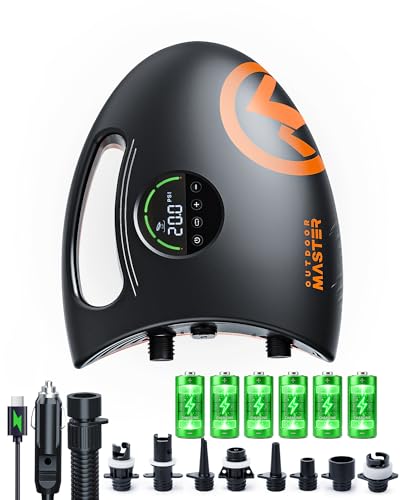 OutdoorMaster Shark 2S Rechargeable Electric Paddle Board Pump | Check price on Amazon |
Key takeaways
- Three verified electric high-pressure SUP pumps compared by max pressure, power source, cooling and auto-off, for inflatable paddle boards.
Disclosure: As an Amazon Associate, we earn from qualifying purchases.
Our top pick: OutdoorMaster Shark High Pressure SUP Pump, 2nd Gen (OP20). Runner-up: OutdoorMaster 20 PSI High Pressure SUP Air Pump Shark, 12V DC.
An inflatable paddle board pump has a harder job than a pool-toy pump. A stand up paddle board is a high-pressure inflatable: it needs a pump that can push a large volume of air at low pressure first, then keep working against rising resistance until the board reaches its recommended working pressure and feels rigid on the water. A pump that stalls partway leaves a soft, flexing board that tracks poorly, while a pump with no automatic shut-off asks the user to watch a gauge the whole time. The three pumps in this guide are all electric high-pressure pumps built specifically for SUPs and similar inflatables, and each one was checked against a real Amazon US listing with a verified ASIN. All three come from the same brand family, OutdoorMaster, because that brand dominates this exact category on Amazon US; they are nevertheless distinct models with different power arrangements, and the differences between them are what this guide is about. This guide covers only those three verified models, rather than padding the list with hand pumps or models whose listings could not be verified.
Quick Picks
- OutdoorMaster Shark High Pressure SUP Pump, 2nd Gen (OP20) — Best overall: 20 PSI maximum, dual-stage inflation, active cooling and auto-off in the second-generation Shark design.
- OutdoorMaster 20 PSI High Pressure SUP Air Pump Shark, 12V DC — Best straightforward car-powered pick: 20 PSI, dual-stage inflation, auto-off and a deflation function, running from a 12V car connector.
- OutdoorMaster Shark 2S Rechargeable Electric Paddle Board Pump — Best away from the car: a built-in 88.8Wh battery that inflates around six SUPs per charge, with 20 PSI, auto-off and eight nozzles.
OutdoorMaster Shark High Pressure SUP Pump, 2nd Gen (OP20)
OUR TOP PICK
The second-generation Shark is the most complete version of the original Shark formula, and the pump to start with for most paddlers. As stated on the listing, it is model OP20, with a maximum pressure of 20 PSI. That ceiling matters because it sits above the working pressure of the great majority of inflatable paddle boards, so the pump is not straining at its limit on a typical board; it can reach the target, hold its pace through the final high-pressure stage, and stop there. A pump whose maximum sits only just above a board’s recommended pressure tends to slow dramatically near the end of the job, and the last stretch of inflation is exactly where a board gains its rigidity.
The mechanism behind that pace is dual-stage inflation. In the first stage the pump moves a high volume of air at low pressure, filling the board’s shape quickly while resistance is low. Once pressure builds, it switches to the second stage, a high-pressure stage that trades volume for force and tops the board up to the set pressure. Doing both jobs with one stage is where lesser pumps struggle: a single high-volume stage cannot push against a nearly rigid board, and a single high-pressure stage takes a very long time to fill an empty one. The two-stage layout is the defining feature of a purpose-built SUP pump, and all three pumps in this guide have it.
The other feature that separates the second-generation Shark is active cooling. An electric pump working through the high-pressure stage generates heat, and heat is what forces rest breaks on long inflation jobs. Active cooling is stated on the listing for this model, and it is aimed at back-to-back use: inflating more than one board at a launch site, or a large board on a warm day, without pausing to cool down between boards. For a solo paddler it is a quiet background benefit; for a family with several boards, it decides whether the second and third boards inflate at the same pace as the first.
Auto-off completes the picture. The user sets the target pressure, starts the pump, and the pump stops by itself when the board reaches that pressure. That removes the two classic errors of electric inflation: stopping early and paddling a soft board, or letting a pump keep pushing past the target. Taken together — 20 PSI, dual-stage inflation, active cooling and auto-off — the OP20 is the most fully equipped of the three models here, which is why it is the top pick.
Specs
– Model: OP20, 2nd generation
– Maximum pressure: 20 PSI, as stated on the listing
– Inflation: dual-stage, as stated on the listing
– Cooling: active cooling system, as stated on the listing
– Shut-off: auto-off at the set pressure, as stated on the listing
Pros
– 20 PSI maximum covers the working pressure of typical inflatable paddle boards with headroom
– Dual-stage inflation fills the board quickly, then finishes it to full pressure
– Active cooling suits back-to-back boards and warm launch sites
– Auto-off stops the pump at the set pressure without supervision
Cons
– A corded design, so it needs a power source at the launch site rather than working anywhere on the beach
– More pump than a low-pressure inflatable kayak or raft requires
OutdoorMaster 20 PSI High Pressure SUP Air Pump Shark, 12V DC
The 12V DC version of the Shark is the straightforward car-powered option in the Shark family. As stated on the listing, it reaches a maximum pressure of 20 PSI and runs from a 12V car connector, which defines both its strength and its setting: it is a pump designed to live in the car and work at the car park, the boat ramp or the campsite pitch where the vehicle is parked. For the many paddlers who drive to the water and inflate beside the car, that is not a limitation at all — it is the simplest possible arrangement, with no battery to remember to charge the night before and no runtime limit beyond the car’s own supply.
It shares the core Shark working method with the top pick. Dual-stage inflation is stated on the listing: a high-volume first stage to fill the board, then a high-pressure second stage to bring it up to working pressure. Auto-off is also stated, so the user sets the target pressure and the pump stops itself when the board gets there. Those two features are the ones that make an electric SUP pump genuinely hands-free, and this model keeps both.
Where this model adds something of its own is deflation. The listing states an auto-off and deflation pairing, and the deflation function earns its place at the end of the day. Squeezing a board’s air out by hand — rolling it from the nose and pushing air toward the valve — is slow and rarely complete, which makes the board bulky to roll and awkward to fit back into its bag. A pump that can pull air out as well as push it in leaves the board flatter, rolls it tighter, and shortens the packing-up routine on every trip.
Choose this Shark when the routine is simple: one car, one or two boards, inflation at the vehicle, and no need to carry a pump across a beach to the water’s edge. It covers the same 20 PSI ceiling as the top pick, keeps dual-stage inflation and auto-off, and adds deflation for pack-down. What it does not add is freedom from the vehicle — the 12V connector is its power source, so a launch point far from parking means choosing the rechargeable model below instead.
Specs
– Maximum pressure: 20 PSI, as stated on the listing
– Power: 12V DC, via car connector, as stated on the listing
– Inflation: dual-stage, as stated on the listing
– Functions: auto-off and deflation, as stated on the listing
Pros
– 20 PSI maximum with dual-stage inflation and auto-off, the same core method as the top pick
– Deflation function pulls air out for a flatter, tighter roll at pack-down
– Runs from the car’s 12V connector, with no battery to charge in advance
– Simple, single-purpose design for paddlers who always inflate beside the vehicle
Cons
– Tied to the car by its 12V connector, so it cannot inflate at a launch point far from parking
– No built-in battery, unlike the rechargeable Shark 2S below
OutdoorMaster Shark 2S Rechargeable Electric Paddle Board Pump
The Shark 2S answers the one question the two corded Sharks cannot: what if the water is not next to the car? As stated on the listing, it is a rechargeable electric paddle board pump with a built-in battery of 88.8Wh, and that battery is stated to inflate around six SUPs per charge. Six boards is a generous working allowance — more than a pair of paddlers will usually need in a day — and it changes where inflation can happen. The pump can be carried to the water’s edge, used on a jetty, taken to a lakeside pitch, or kept with the boards rather than with the vehicle. For paddlers who park and walk, who launch from a beach reached on foot, or who simply dislike inflating in a car park, that freedom is the whole point of the model.
Its inflation credentials match the corded models. The maximum pressure is stated as 20 PSI, the same ceiling as the other two pumps here, and auto-off is stated as well, so the set-and-stop routine is unchanged: dial in the target pressure and let the pump finish the board on its own. A rechargeable pump that gave up pressure or supervision to gain its battery would be a poor trade; on the figures recorded from the listing, the 2S does not ask for that trade.
Charging flexibility is the other half of its design. The listing states 12V and 15.8V DC input alongside Type-C input, so the battery can be topped up from a vehicle supply or from a modern USB-C charger of the kind already carried for phones. That matters on multi-day trips, where the pump can be recharged in the evening from whatever power is at hand. The listing also states eight nozzles are included, which widen the pump’s usefulness across other inflatables — kayaks, rafts, air beds and towables — each with its own valve fitting, so one pump can cover the whole pile of inflatable gear in a garage rather than just the boards.
The honest trade-offs are about battery discipline. A corded pump is always ready; a rechargeable pump is ready only if it was charged. The around-six-boards figure is a per-charge allowance, so a long trip with many boards means planning recharges between sessions, and a flat battery at the launch site means falling back to a hand pump. The 2S is the model to choose when portability is worth that small amount of planning. One further note: its ASIN string looks unusual, but it is printed as-is in the Amazon listing copy checked for this guide; a quick check of the live product page before ordering is a sensible final step.
Specs
– Battery: 88.8Wh built-in, stated to inflate around six SUPs per charge, as stated on the listing
– Maximum pressure: 20 PSI, as stated on the listing
– Input: 12V and 15.8V DC, and Type-C, as stated on the listing
– Shut-off: auto-off at the set pressure, as stated on the listing
– Included nozzles: eight, as stated on the listing
Pros
– Built-in battery inflates around six SUPs per charge, away from any vehicle
– Same 20 PSI maximum and auto-off as the corded Sharks
– Charges by DC input or Type-C, which suits multi-day trips
– Eight included nozzles cover other inflatables beyond paddle boards
Cons
– Only works as a cordless pump if the battery was charged beforehand
– Around six boards per charge sets a planning limit on long, board-heavy trips
– Its ASIN string is unusual, so confirm the live product page before ordering
How to Choose
Start with pressure, because it is the specification that decides whether a pump can do the job at all. An inflatable paddle board needs a pump whose maximum pressure sits comfortably above the board’s recommended working pressure. All three pumps in this guide are stated to reach 20 PSI, which covers typical boards with headroom. A low-pressure pump made for air beds and pool inflatables may move air quickly at first, but it cannot finish a paddle board; it stalls against the board’s resistance and leaves it soft. If a pump’s listing does not state a maximum pressure in PSI, it is not a SUP pump, whatever its shape.
Next, insist on dual-stage inflation. The first stage is about volume: an empty board is a large bag of air, and filling that shape with a high-pressure mechanism alone takes a long time. The second stage is about force: once the board is full and resistance rises, only a high-pressure stage can bring it to working pressure and make it rigid. All three models here state dual-stage inflation, and that shared feature is a large part of why this guide contains these three and not a longer list of cheaper single-stage pumps.
Then choose the power source that matches the launch routine, because that is where the three models genuinely differ. The second-generation Shark, model OP20, is the pick when the pump will work where power is available and more than one board may be inflated in a row; its active cooling is the feature aimed at that repeated work. The 12V DC Shark is the pick when inflation always happens beside the car; it never needs charging, and its deflation function speeds up packing the board away afterwards. The Shark 2S is the pick when the launch point is away from the vehicle, or when one pump has to move between cars, campsites and beaches; its battery covers around six boards per charge, and its DC and Type-C inputs make recharging on a trip straightforward.
After power, think about supervision. Auto-off, stated for all three models, is worth treating as essential rather than optional. It protects the board from over-inflation when the user is distracted, and from under-inflation when the user is impatient. A pump without it ties one person to the board for the full inflation time, watching a gauge; with auto-off, those minutes overlap with rigging fins, attaching leashes and loading the rest of the gear.
Finally, consider what else the pump will be asked to inflate. A household with only paddle boards needs only the board valve fitting. A household with an inflatable kayak, a raft or air beds for camping will get real value from the Shark 2S and its eight stated nozzles. Match the pump to the whole inflatable collection, not just to the board bought most recently, and the choice between these three usually makes itself.
FAQs
Can a regular electric air pump inflate a paddle board?
Usually not to working pressure. Pumps made for air beds and pool toys are low-pressure, high-volume designs: they fill the board’s shape but stall as resistance rises, leaving the board soft and flexible. A paddle board needs a high-pressure pump with dual-stage inflation, like the three models in this guide, each stated to reach 20 PSI, so the board finishes rigid enough to paddle properly.
How long does an electric SUP pump take to inflate a board?
It varies with the board’s size and target pressure, and no inflation time was recorded from the listings checked for this guide, so no figure is stated here. What can be said is what shortens the job: dual-stage inflation, which fills the board quickly before switching to high-pressure work, and active cooling, which on the second-generation Shark is aimed at keeping the pace up across back-to-back boards. Check the live listing for any timing figure given for the specific model.
Which of these pumps works away from a car?
The Shark 2S. Its built-in 88.8Wh battery is stated to inflate around six SUPs per charge, and it can be recharged through its DC inputs or its Type-C input. The other two models are powered designs rather than battery designs: the 12V DC Shark runs from a car connector, so it inflates where the vehicle is, and the second-generation Shark suits launch sites where a power source is at hand.
Conclusion
All three pumps here share the essentials of a proper SUP pump: a stated maximum of 20 PSI, dual-stage inflation and auto-off. The choice between them is about where the inflating happens. The OutdoorMaster Shark, 2nd Gen (OP20) is the top pick, adding active cooling for back-to-back inflation. The 20 PSI Shark with its 12V car connector is the runner-up and the simplest choice for paddlers who inflate beside the vehicle, with deflation to speed up packing away. The Shark 2S is the one to choose when the water is away from the car, with a battery stated to handle around six boards per charge. Before buying, confirm the board’s recommended working pressure, and check the live product page for the model chosen.