Key takeaways
- The best vacuum drying ovens for laboratory upgrades compared: chamber volume, vacuum level, pump bundles, temperature range and shelf layouts explained.
Upgrading a laboratory drying setup usually starts with one frustration: a gravity convection oven that dries slowly, oxidises sensitive samples, or cannot pull solvent out of powders without overheating them. A vacuum drying oven lowers the pressure around the sample, so moisture and solvents leave at gentler temperatures and in less time. The real decision is matching chamber volume, vacuum depth and heating design to the samples that pass through the bench each week.
This guide compares benchtop vacuum drying ovens sold for laboratory work, from compact 0.9 cu ft chambers to a 1.9 cu ft model built for larger batches. Every option here is a true vacuum oven with a sealed, pump-driven chamber, chosen from its Amazon listing specifications: chamber dimensions, stated vacuum level, temperature range and shelf layout. Whether the priority is a pump included in the box or the deepest stated vacuum figure, the picks below cover the main upgrade paths.
Quick Picks
As an Amazon Associate we earn from qualifying purchases
| Product | Best for | Key spec from title |
|---|---|---|
| Across International AT09p7.110 AccuTemp | Complete benchtop upgrade with pump included | 0.9 cu ft, 7 CFM pump |
| Across International AT19P7 | Larger batches in a benchtop format | 1.9 cu ft, 5-sided heating |
| StonyLab Vacuum Drying Oven 24L | Deep stated vacuum in a compact chamber | Below 133 Pa, RT+10-250°C |
| HayWHNKN 0.9 Cu Ft Digital Vacuum Drying Oven | Simple, lower-power drying station | 600W, 2 shelves |
How to Choose
Chamber Volume and Shelf Configuration
Chamber volume decides how much material dries in one run, but the headline figure only helps if your trays and vessels physically fit. Compare the internal dimensions, not just the cubic footage, and check how many shelves are included and how many the chamber can hold at most. Closely spaced shelves suit thin layers of powder or small parts, while wide spacing is better for bottles and taller glassware. For an upgrade, measure the largest load you dry weekly and choose the smallest chamber that holds it comfortably, because oversizing wastes bench space, pump capacity and heat-up time on every single run.
Vacuum Level and Pump Pairing
The vacuum figure on a listing only becomes real with a suitable pump, so check whether one is included or sold separately before comparing models. Ovens state ultimate vacuum in different units: microns, millitorr, pascals or inches of mercury, and the numbers describe the chamber’s capability with an appropriate pump attached. A two-stage rotary vane pump in the 4 to 7 CFM class is the usual partner for benchtop chambers of this size. Also look at the connection standard: KF25 flanges give a leak-tight, tool-free joint, while a plain hose barb is simpler but less secure at deep vacuum.
Temperature Range and Uniformity
Listings in this class top out at 150°C, 200°C or 250°C, and the right ceiling depends on your samples rather than on bragging rights. Heat-sensitive materials often dry under vacuum at modest temperatures, while curing and sterner drying work may need the full 250°C. Just as important is how evenly that heat is delivered: multi-sided pad or wall heating wraps the chamber and reduces cold spots compared with a single element, and a stated uniformity or fluctuation figure, such as ±1°C, tells you how tightly the controller holds the setpoint across a long run.
Controls, Safety and Certification
A PID controller with a clear display, a dwelling timer and over-temperature protection covers the daily needs of most labs, and features such as measurement-error correction help keep an older installation honest. Check the electrical draw as carefully as the temperature range: a 1,500W oven on a 110V circuit needs a properly rated outlet, and heavy benchtop units may arrive by freight rather than parcel. Certification marks such as CE, UL or ETL show the electrical build has been assessed, which matters for institutional purchasing, insurance and any lab that hosts external audits or student users.
The 4 Best Options
Across International AT09p7.110 AccuTemp Vacuum Oven with 7 CFM Pump

The AT09p7.110 is the easiest upgrade path for a bench that has no vacuum infrastructure yet, because a 7 CFM pump arrives in the same package as the oven itself. Its 0.9 cu ft stainless steel chamber suits small-batch drying, degassing and purging, while five-sided pad heating wraps the chamber for more even heat distribution than a single rear element provides. A microcomputer PID controller with an LCD display manages setpoints in Fahrenheit or Celsius, and gas back-fill capability lets you vent the chamber with inert gas instead of room air when finished samples are oxygen-sensitive. KF25 flanges on both ports keep the vacuum connections standard and serviceable.
Specs
- Capacity: 0.9 cu ft
- Chamber: 12 x 12 x 11 in, stainless steel
- Heating: 5-sided pad heating
- Temperature range: ambient to 250°C (480°F)
- Controller: microcomputer PID with LCD display
- Ultimate vacuum: better than 500 microns
- Vacuum and vent ports: KF25 flange
- Included pump: 7 CFM vacuum pump
- Shelves: 4 aluminum shelves included, 8 maximum
- Power: 110V, 60Hz, 1,500W
- Timer: 1 to 9,999 minutes
Best for: Labs upgrading from a basic drying oven that want one matched oven-and-pump package.
Watch out for: The 1,500W draw and roughly 90 lb unit weight mean it needs a suitable circuit and a sturdy bench.
ASIN: B005IGEQR4
Across International AT19P7 1.9 Cu Ft Vacuum Oven with 7 CFM Pump

Stepping up to the AT19P7 roughly doubles working volume to 1.9 cu ft while keeping the same ownership pattern as its smaller sibling: five-sided pad heating, stainless steel tubing and valves throughout, and a bundled 7 CFM compact vacuum pump. An oil-filled vacuum gauge gives steadier readings than a dry gauge and tolerates vibration better, and an LED chamber light makes it easier to watch samples through the window during a run. The listing quotes temperature control within ±1°F and a timer running from 1 to 9,999 minutes with memory and password functions, which suits longer, repeatable drying programmes in busier laboratories.
Specs
- Capacity: 1.9 cu ft
- Model: AT19P7
- Heating: 5-sided pad heating
- Tubing and valves: stainless steel
- Vacuum gauge: oil-filled
- Chamber light: LED
- Included pump: 7 CFM compact vacuum pump
- Temperature control: within ±1°F per listing
- Timer: 1 to 9,999 minutes, with memory function
- Power: 110V
- Item weight: 140 lb
Best for: Labs whose 0.9 cu ft chamber has become the bottleneck and that dry larger or more frequent batches.
Watch out for: At 140 lb it is a freight-style delivery and a two-person lift, so plan bench placement before it arrives.
ASIN: B00JXW0YA2
StonyLab Vacuum Drying Oven 24L
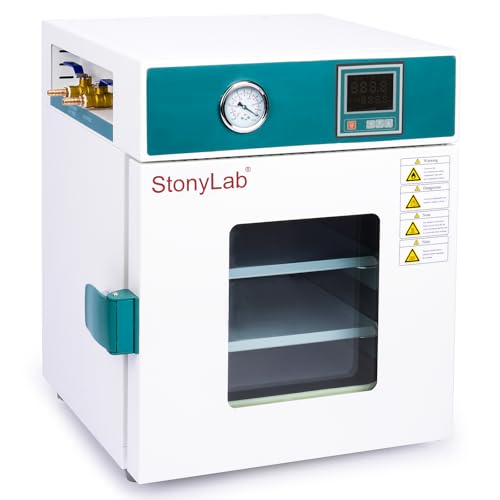
The StonyLab oven is the precision-leaning compact option, built around a 24 L stainless steel chamber with four-wall heating and a stated vacuum below 133 Pa. Its dual-temperature intelligent PID controller sets temperature in 0.1°C steps and holds uniformity at ±1°C across a range running from 10°C above ambient up to 250°C, which helps heat-sensitive materials that cannot tolerate overshoot. A bulletproof tempered glass observation window and a pointer-type vacuum gauge keep monitoring straightforward, the timer runs up to 9,999 minutes for long unattended cycles, and CE certification covers the electrical build for compliance-minded buyers.
Specs
- Capacity: 24 L (0.9 cu ft)
- Chamber: 300 x 300 x 270 mm, stainless steel
- Temperature range: RT+10 to 250°C
- Temperature uniformity: ±1°C
- Setting accuracy: 0.1°C
- Vacuum: below 133 Pa
- Heating: four-wall heating
- Controller: dual-temperature intelligent PID
- Timer: 0 to 9,999 minutes
- Observation window: bulletproof tempered glass
- Vacuum gauge: pointer type, accuracy class 1.6
- Power: 110V, 0.8 kW
- Certification: CE
Best for: Smaller labs that prioritise a deep stated vacuum and fine temperature resolution in a benchtop footprint.
Watch out for: No pump is bundled, so budget and bench space for a separate pump that can reach the stated vacuum.
ASIN: B08T6HXJ5K
HayWHNKN 0.9 Cu Ft Digital Vacuum Drying Oven

The HayWHNKN oven covers the fundamentals of vacuum drying in a compact 0.9 cu ft chamber of 304 stainless steel, with an LCD controller whose output power is adjustable and which can correct temperature measurement errors. Its 50 to 200°C range and ±1°C fluctuation suit routine drying of powders, components and samples that never need the highest setpoints. The listing states a vacuum degree below 133 Pa and a dwelling timer of up to 9,999 minutes. Two shelves are included, the door closes on a one-piece sealing gasket with a force-adjustable handle, and a dual-layer tempered glass window allows visual checks mid-run.
Specs
- Capacity: 0.9 cu ft
- Chamber: 300 x 300 x 275 mm, 304 stainless steel
- Temperature range: 50 to 200°C
- Temperature fluctuation: ±1°C
- Vacuum degree: below 133 Pa
- Power: 110V, 600W
- Controller: LCD display with adjustable output
- Timer: 1 to 9,999 minutes
- Shelves: 2 included
- Window: dual-layer tempered safety glass
- Pump: not included; pipe included
Best for: Routine laboratory drying where a 200°C ceiling is enough and a gentler electrical draw is useful.
Watch out for: The lower temperature ceiling and two-shelf layout limit high-temperature work and batch size.
ASIN: B0CX8NSJCV
Which One Fits Your Situation
Replacing a Gravity Oven on a Crowded Bench
If bench space is the binding constraint, stay in the 0.9 cu ft class and favour a package that includes its pump, so no second footprint appears beside the oven. The AT09p7.110 covers that brief directly, while the StonyLab 24L is the alternative when you already own a capable pump and want the deeper stated vacuum and finer temperature steps in the same compact size.
Drying Larger or More Frequent Batches
Throughput problems are solved by volume and shelf count, not by higher temperatures. The AT19P7 doubles chamber capacity to 1.9 cu ft and keeps the pump-included format, so a growing lab can standardise on one control style. Check that your largest trays fit the chamber dimensions and that the bench and circuit can carry a 140 lb, full-size benchtop unit before ordering.
Heat-Sensitive and Oxygen-Sensitive Samples
For materials that degrade with heat or air, vacuum depth and gentle, even heating matter more than raw capacity. Look for multi-sided heating, a controller with fine resolution, and a way to back-fill with inert gas at the end of the run. The AT09p7.110’s gas back-fill and the StonyLab’s 0.1°C setting steps both address this kind of work directly.
Teaching and Quality-Control Labs
Where several people share one oven, simple controls, a readable gauge and a wide observation window reduce mistakes. Certification also carries more weight in institutional settings. The StonyLab’s CE-certified build, pointer gauge and timed auto-stop operation suit supervised environments, while any oven chosen for students should have its over-temperature behaviour and door gasket condition checked on a schedule.
Common Mistakes
- Choosing by headline chamber volume without checking internal dimensions and shelf spacing against your actual trays and vessels.
- Assuming a vacuum pump is included, then discovering the oven alone cannot reach its stated vacuum figure.
- Comparing vacuum specifications across listings without converting units, since pascals, microns and inches of mercury describe very different depths.
- Buying a 250°C oven for samples that only ever dry at 80°C, or a 150°C or 200°C model that cannot reach a required curing temperature.
- Forgetting the installation basics: circuit capacity for a 1,500W load, bench strength for a heavy cabinet, and freight delivery for larger units.
Frequently Asked Questions
Does a vacuum drying oven need a separate vacuum pump?
Usually, yes. The oven provides the heated, sealed chamber, and a pump connected to its vacuum port produces the low pressure. Some packages, like the two Across International models above, bundle a matched pump, while others, like the StonyLab and HayWHNKN, expect you to supply one with enough pumping speed and ultimate vacuum for the chamber size.
What vacuum level does laboratory drying actually need?
Most routine drying only needs a rough-to-medium vacuum to lower boiling points and speed moisture removal. Listings here state figures below 133 Pa or better than 500 microns, both deep enough for typical solvent and moisture work. Chasing the deepest number matters mainly for demanding degassing, and it depends as much on the pump and seals as on the oven itself.
Can a vacuum oven replace a standard drying oven completely?
Not for every task. Vacuum ovens excel with heat-sensitive, oxygen-sensitive or solvent-bearing samples, but a forced-air oven is still quicker for bulky, water-heavy loads that tolerate heat and air. Many upgraded labs keep both: the convection oven handles routine glassware and media, while the vacuum oven takes the delicate work where lower temperatures and an oxygen-free environment protect the sample.
How should a new vacuum oven be prepared before first use?
Manufacturers of these ovens direct users to run the empty chamber at a high temperature without vacuum for a short period before first use, which burns off manufacturing residue. After that, verify the gauge reading with your pump attached, check the door gasket seats evenly, and run a familiar sample load before trusting the oven with valuable material.