Key takeaways
- Start at the lowest speed with the softest head and move slowly over the muscle belly.
- Keep the gun moving rather than holding it in one spot, and keep sessions short, as the manual advises. Many makers advise a limited time per muscle group, so check yours.
- Use light pressure and let the head do the work. Pressing hard does not improve results and increases the risk of bruising.
- Avoid bones, joints, the spine, the front of the neck, the head, and any injured or numb areas.
- Stop if you feel sharp pain, tingling, numbness or dizziness.
- Do not use it while driving, in water, or when it is charging, and keep it out of reach of children.
For most buyers, a mid-sized percussion massage gun with several speed settings, interchangeable heads and a battery that lasts a few sessions is the sensible target at under $150, a compact mini gun suits travel and gym bags, and the heaviest professional-grade guns with long amplitude and high stall force sit in the premium tier above this cap. This guide explains how to read a massage gun’s spec sheet so you can compare any model, and it does not rank individual models, because makers’ specs and versions change often and should be read from the maker’s own page.
Our top picks


As an Amazon Associate we earn from qualifying purchases at no extra cost to you.
What a massage gun is, and what it is not
A massage gun is a handheld device with a head that moves rapidly in and out, delivering short percussive pulses to muscle. People use them to warm up before exercise, to relax muscles afterwards and to ease the feeling of tightness. They are consumer wellness tools. They are not treatments for injuries or medical conditions, and the makers’ own manuals typically list who should not use them. Do not use one on a recent injury, a bruise, swollen or broken skin, varicose veins, areas of numbness, or directly on bones, joints, the spine, the front of the neck or the head. People who are pregnant, have a pacemaker or other implant, a blood clotting disorder, take blood thinners, have diabetes or neuropathy, or have a history of blood clots should ask a physician first. If you have pain that is severe, lasts or follows an injury, see a doctor or physiotherapist.
What the cap buys
Massage guns are sold across budget, mid-range and premium tiers. Budget and mid-range models from many brands fit a cap like this, and they often share the same core parts: a brushless motor, a rechargeable lithium battery and a set of attachment heads. Premium models from the best-known wellness brands generally add stronger motors, quieter operation, app connectivity and refined ergonomics. A budget under $150 is enough for a good gun for general use, though it will not match the quietest or most powerful premium units. Individual prices vary by seller and bundle and are not quoted here.
The specs that matter
Amplitude (stroke length)
Amplitude, usually stated in millimetres, is how far the head travels. A longer stroke reaches deeper into large muscles such as the quads and glutes, while a shorter stroke feels lighter and suits smaller areas and sensitive users. Makers define and measure amplitude differently, so compare numbers with care, and treat a stated figure as the maker’s claim. If a listing does not state amplitude, that is useful information in itself.
Speed settings and percussions per minute
Most guns list several speed levels, often in percussions per minute. More levels give finer control, but a low, usable first setting matters more than a high top speed. Beginners should start at the lowest speed and increase only as it feels comfortable.
Stall force and motor quality
Stall force describes how much pressure you can apply before the head stops. A gun with low stall force can stall when pressed into large muscles, which makes the stated figure useful when comparing guns for heavy use. Not every maker lists it. You do not need to press hard: most guidance says to let the device do the work.
Battery life and charging
Check the stated battery life in hours and the charging method. Models with a USB-C port are easier to charge from common chargers. Batteries lose capacity over time, so a unit with a generous stated life will still last longer after a year of use. Follow the maker’s charging instructions and use the supplied cable.
Noise
Noise is a comfort factor, especially if you use the gun late at night or near others. Makers sometimes list decibel figures, though measurement methods differ. Brushless motors are generally described as quieter, and premium models tend to market their noise levels more heavily.
Attachment heads
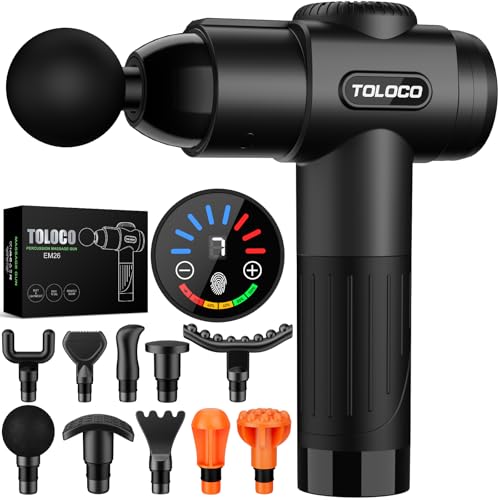
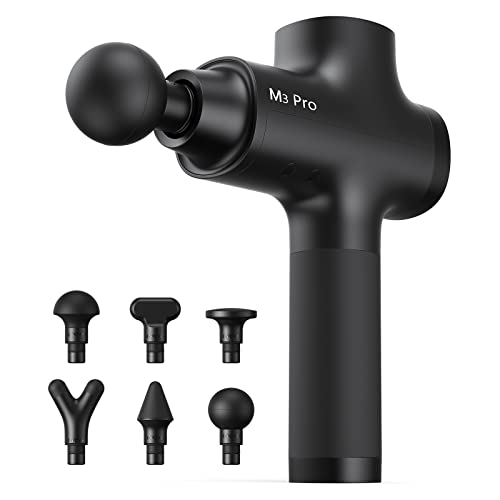
Most guns include several heads: a ball for large muscle groups, a flat head for general use, a bullet or cone for small points and a fork or U-shaped head for around the spine’s sides or the calf. Do not use the fork head on bones or the spine itself. A small set of well-made heads is better than a long list of attachments you will never use.
Weight and ergonomics
A heavy gun gets tiring to hold, and an awkward handle makes it hard to reach your own back. Look for a stated weight, a handle angle that suits your reach and a grip you can hold comfortably. Some guns have a triangle or an angled handle for easier reach.
Makers worth looking at
Therabody (Theragun), Hyperice (Hypervolt) and Renpho are well-known makers of percussion massagers, and many other brands sell budget and mid-range guns. Premium lines from the best-known names are often above this cap, while their smaller or older models and the mid-range brands are where a budget buyer usually looks. Because lineups are refreshed often and discontinued models linger in listings, open the maker’s page for the exact model, confirm it is still sold, and read the amplitude, speed range, battery life, weight and manual cautions it states. If a listing and the maker’s page disagree, listings differ and the maker’s page is the one to trust. Be wary of listings that promise to treat injuries, break up scar tissue or cure pain, since makers’ own manuals frame these devices as general wellness tools.
At a glance: types of massage gun
| Type | Typical traits | Best for | Limits |
|---|---|---|---|
| Mini or compact gun | Small body, lighter, shorter battery and often shorter amplitude | Travel, gym bag, neck and shoulder touch-ups | Less depth, can stall on large muscles |
| Mid-size standard gun | Several speeds, a set of heads, mid-range battery | General use for most adults | Heavier than a mini |
| Large, high-torque gun | Long amplitude, high stall force, heavier | Large, muscular users and frequent training | Often premium tier; heavy; louder |
| Wireless with a stand and display | Digital display, charging dock | Home use with easy storage | More features that may not be needed |
| Heated or app-linked guns | Extras such as heat or guided routines | People who like routines | Heat adds a safety consideration; follow the manual |
Pick X if…
| If you… | Choose | Why |
|---|---|---|
| Want one gun for general use | Mid-size standard gun with a stated amplitude and several speeds | Balanced power and weight |
| Travel or train away from home | Mini gun with a USB-C port | Fits a bag, charges anywhere |
| Have large muscles and train often | A gun with higher stated stall force and amplitude | Less likely to stall |
| Are sensitive or new to percussion | A gun with a gentle low speed and a short stroke | Easier to tolerate |
| Share it with others | A gun with a clear speed display and removable heads | Easy to reset and clean |
| Have a medical condition | Ask your physician before buying | Safety first |
How to use a massage gun sensibly
- Start at the lowest speed with the softest head and move slowly over the muscle belly.
- Keep the gun moving rather than holding it in one spot, and keep sessions short, as the manual advises. Many makers advise a limited time per muscle group, so check yours.
- Use light pressure and let the head do the work. Pressing hard does not improve results and increases the risk of bruising.
- Avoid bones, joints, the spine, the front of the neck, the head, and any injured or numb areas.
- Stop if you feel sharp pain, tingling, numbness or dizziness.
- Do not use it while driving, in water, or when it is charging, and keep it out of reach of children.
Care and charging
Wipe heads and the body with a slightly damp cloth, dry them and store the gun in its case. Do not submerge it. Charge with the supplied cable, avoid leaving it on a charger for long periods if the manual says not to, and keep it away from high heat. Lithium batteries should be treated carefully: stop using a unit that swells, smells or becomes unusually hot and ask the maker or a recycling point about disposal. Follow the manual for lubrication or cleaning. Check that heads are tightly seated before each use.
Alternatives
- Foam roller or massage ball: low-cost, no battery, and you control the pressure with your body weight.
- Handheld vibrating massager: gentler than a percussion gun and easier on sensitive users.
- Shiatsu pad: for seated back tension, a pad is more convenient than a gun, which is hard to use on your own mid-back.
- Professional massage or physiotherapy: useful for persistent tightness or after injury, because a trained professional can assess the cause.
Frequently Asked Questions
How long should I use a massage gun on one area?
Manuals commonly advise short periods on each muscle group, and totals per session are usually modest, but the exact guidance varies by maker. Follow your device’s manual, and stop sooner if the area feels sore or tender.
Is a higher amplitude always better?
No. A longer stroke reaches deeper and suits larger muscles, but it can feel too intense for smaller areas or for beginners. Pick the amplitude that matches how you will use it, and remember makers measure it in different ways.
Can I use a massage gun on my back?
You can use it on the muscles beside the spine, such as the upper back and shoulders, if you can reach them, but never directly on the spine itself. A long handle or a second person helps, and a shiatsu pad can be easier for the middle back.
Will a massage gun help me recover faster?
Many people find the feeling of relief pleasant, and makers market recovery benefits. A massage gun is not a treatment, though, and results vary. Sleep, hydration and a sensible training load matter more. For persistent pain, see a physician.
Who should not use a massage gun?
People with implants such as pacemakers, clotting disorders, those on blood thinners, pregnant women, people with nerve conditions or diabetes, and anyone with an injury or inflamed area should speak to a doctor first. Read the manual’s warnings carefully.
How do I choose between a mini and a full-size gun?
A mini gun is lighter and easier to carry, but typically has a smaller motor and shorter battery life. A full-size gun suits regular use on larger muscles. If you want only one, a mid-size gun covers most needs, and a mini is a good second device for travel.