Key takeaways
- Compare 5 overhead laboratory stirrers for product development, from 10L analog models to 20L digital mixers for thick formulations, with capacity, speed and viscosity specs from Amazon listings.
Choosing an overhead laboratory stirrer for product development is really a decision about repeatability. A formulation that mixes cleanly in a 500 ml beaker can separate, trap air, or stall the motor entirely when the same recipe moves to a 10-litre vessel with a thicker base. The wrong stirrer wastes a batch, hides a stability problem until later testing, and forces the team to redo work that should have been settled at the bench.
This guide is for formulators, lab technicians, and small product teams who mix creams, gels, emulsions, adhesives, inks, or food and cosmetic prototypes and need the same result every time they run a batch. Every product below was selected from its name and stated specifications on its Amazon listing, so capacity, speed range, viscosity limit, and included accessories can be compared on the same terms before ordering.
Quick Picks
As an Amazon Associate we earn from qualifying purchases.
| Product | Best for | Key spec from title |
|---|---|---|
| ONiLAB LCD Digital Overhead Stirrer, 20L, with Stand | Larger pilot batches that need a digital readout | 20L, 10000 mPas, 50-2200 RPM, stand included |
| ONiLAB Lab Analog Overhead Stirrer, 10L | Simple bench work with a stand and two rods included | 10L, 100-2500 rpm, Max. Viscosity 10000 mpas |
| ONiLAB OLED Digital Overhead Stirrer, 10L | Compact digital control for small formulation trials | 10L, 10000 Mpas, 200-2500 rpm |
| Fristaden Lab Analog Overhead Stirrer, 10L | Straightforward analog mixing of thick small batches | 10L, 100-2000 RPM, 10000 mPa-s |
| JOANLAB Overhead Stirrer, 20L, Without Stand | Timed 20L runs where a stand is already available | 20L, 20000 mPas, 100-1500 RPM, timing 1 min-24 h |
How to Choose
Match capacity and viscosity to the thickest batch, not the average one
A stirrer rated for 20 litres of water will not necessarily handle 20 litres of a gel or a filled adhesive, because viscosity, not volume alone, decides how hard the motor works. Start from the thickest formula the team expects to develop, then check the maximum viscosity in mPas alongside the maximum stirring quantity. A 10,000 mPas limit covers many creams and emulsions, while a 20,000 or 30,000 mPas rating gives more headroom for pastes and heavy gels. If the thickest trial sits close to the stated limit, choose the larger rating rather than hoping a slower speed will compensate.
Decide how much speed control a development run actually needs
Product development often means changing one variable at a time, and speed is one of the easiest to record. A digital display that shows set and actual speed makes it simple to write the exact setting into a batch record and repeat it next week. Analog dials are faster to adjust during a quick trial and have fewer menus to learn, yet the setting is harder to reproduce exactly. For timed experiments, a model with a built-in timer removes the need for a separate stopwatch and keeps the mixing duration consistent between batches.
Check torque, motor type, and the chuck before the impeller
Torque decides whether the stirrer keeps turning when a batch thickens midway through mixing, while the motor type affects how long the unit can run without attention. Brushless DC motors are listed on several models here for low-noise, maintenance-free operation, which matters during long development runs. The chuck range also matters in practice: a 0.5-10 mm chuck accepts the common stirring rods and impellers used for bench vessels, so confirm that the rods supplied match the vessel depth and the viscosity of the batch before ordering a separate impeller.
Plan the bench setup, stand, and safety features together
An overhead stirrer is only as stable as its mounting. Some listings include a support stand and stirring rods, others sell the stirrer head alone and expect the buyer to supply a stand, so the total bench footprint and the height of the tallest vessel need checking in advance. Overload protection appears on several listings here and helps the motor shut down or warn the operator when the load becomes too high, instead of stalling silently. Leave clearance around the vessel for adding ingredients, and keep the chuck, rod, and impeller clean between formulations to avoid carrying one trial into the next.
The 5 Best Options
ONiLAB LCD Digital Overhead Stirrer, 20L, with Stand

This ONiLAB model suits teams that have moved beyond small beakers and need a documented, repeatable setup for pilot-size batches. Its LCD display shows speed and torque, which makes it easier to record the exact conditions behind a successful emulsion or dispersion and to spot when a thickening batch is loading the motor. The included stand removes one purchasing decision, and the brushless motor is built for sustained bench use rather than short bursts. For a development lab that runs the same formulation at increasing scale, that combination of capacity and visible feedback is the practical point of the purchase.
Specs
- Maximum stirring quantity: 20L
- Speed range: 50-2200 rpm
- Maximum viscosity: 10,000 mPa·s
- Maximum torque: 40 N·cm
- Motor type: Brushless DC motor
- Display: LCD display of speed and torque
- Overload protection display: LCD
- Chuck clamp range: 0.5-10 mm
- Item model number: 8053100100
- Support stand included
Best for: Pilot batches up to 20 litres where speed and torque need to be read and recorded during the run.
Watch out for: The 10,000 mPas viscosity limit will not suit very heavy pastes, so check the thickest formula against that figure before scaling up.
ONiLAB Lab Analog Overhead Stirrer, 10L

This analog ONiLAB stirrer is a good fit for benches where the work changes often and the operator wants direct control without navigating a digital menu. Its speed range reaches 2,500 rpm, which gives room for fast dispersion in thinner liquids as well as slower stirring for thicker mixes, and the package includes a support stand with two stirring rods, so the unit can be set up without buying accessories separately. Overload protection is listed for the model, adding a layer of motor protection when a batch thickens unexpectedly. For straightforward formulation trials, the analog layout keeps the workflow simple.
Specs
- Maximum stirring quantity: 10L
- Speed range: 100-2500 rpm
- Maximum viscosity: 10,000 mPas
- Maximum torque: 20 Ncm
- Chuck range diameter: 0.5-10 mm
- Motor type: DC motor
- Input power: 45W
- Overload protection included
- Support stand and two stirring rods included
- Voltage: 110-220V
Best for: Small development benches that want a complete 10L analog setup with stand and rods in one purchase.
Watch out for: An analog dial does not show an exact digital speed reading, so record the dial position and check the result rather than assuming the same setting twice.
ONiLAB OLED Digital Overhead Stirrer, 10L

This OLED digital model from ONiLAB targets the same 10-litre bench scale as the analog version above, but it trades the dial for a digital display and a higher top speed. That makes it useful when a formulation protocol specifies an exact speed, because the operator can set and read the value instead of estimating from a knob position. The 10,000 mPas viscosity rating covers a wide range of creams, lotions, and emulsions, and overload protection is listed for the unit. It is a compact choice for teams that run many small trials and need each one to be easy to reproduce.
Specs
- Maximum stirring quantity: 10L
- Speed range: 200-2500 rpm
- Maximum viscosity: 10,000 mPas
- Overload protection included
- Item model number: OS10-PRO
- Display: OLED digital display
Best for: Small-batch formulation trials where an exact digital speed setting matters more than a large vessel capacity.
Watch out for: The 200 rpm minimum speed is higher than some analog models, so very gentle stirring of delicate mixtures may need a different approach.
Fristaden Lab Analog Overhead Stirrer, 10L
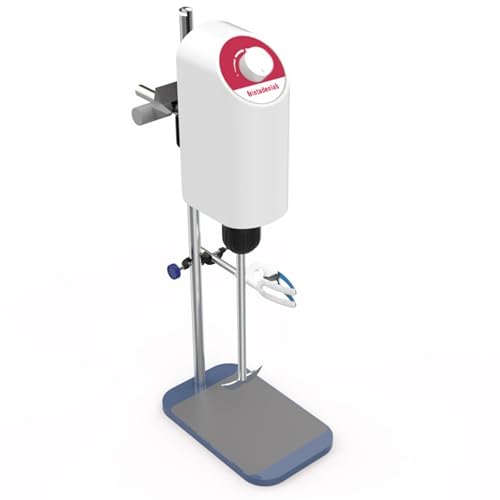
The Fristaden Lab analog stirrer takes a deliberately simple approach to 10-litre bench mixing, with an analog control panel and a stainless steel stirring setup suited to laboratory work. Its 60W motor output is stated as double the output of typical models in the listing, which is relevant when a cream or gel thickens during mixing and the stirrer needs to keep turning. The 10,000 mPa-s viscosity rating matches the other 10-litre models in this guide, so the choice here comes down to preferring analog control and a heavier-duty motor feel over a digital display. A one-year warranty is stated in the listing title.
Specs
- Maximum stirring quantity: 10L
- Speed range: 100-2000 rpm
- Maximum viscosity: 10,000 mPa-s
- Motor output: 60W
- Item model number: OS-10L
- Stainless steel lab stirrer
- Analog control panel
- 1-year warranty stated in the listing title
Best for: Thick 10-litre batches where simple analog control and a stronger motor output are more useful than a digital readout.
Watch out for: Sources differ on whether the lower speed limit is 100 or 200 rpm, so confirm the stated range on the listing at the time of ordering.
JOANLAB Overhead Stirrer, 20L, Without Stand

This JOANLAB model is the option for teams that already own a suitable stand and want a larger 20-litre capacity with a higher viscosity ceiling. Its 20,000 mPas rating gives more room for thick gels, pastes, and filled formulations than the 10,000 mPas models above, and the built-in timing function, listed as 1 minute to 24 hours, supports long, unattended-style development runs where the mixing duration is part of the protocol. Stirring rods are included, while the stand is not, so the buyer needs a compatible support already on the bench. That trade-off keeps the purchase focused on capacity and timing rather than accessories.
Specs
- Maximum stirring quantity: 20L
- Speed range: 100-1500 rpm
- Maximum viscosity: 20,000 mPas
- Timing range: 1 min-24 h
- Stirring rods included
- Stand not included
- Motor type: Brushless DC motor
- Self-lock drill chuck
- Item model number: OS-15S (w/o Stand)
Best for: Timed 20L development runs with thick formulations, on a bench that already has a compatible stand.
Watch out for: No stand is included with this variant, so a buyer without one will need to source a support that fits the stirrer and vessel height.
Which One Fits Your Situation
You run small formulation trials and change recipes often
Choose the ONiLAB OLED Digital Overhead Stirrer, 10L, ASIN B0CD23P9KQ. Its digital display makes it easy to note the exact speed used for each trial, and the 10-litre capacity is large enough for most bench-scale creams and emulsions without taking over the bench. The analog ONiLAB 10L is the simpler alternative when a dial is preferred.
Your batches thicken as they mix
Choose the JOANLAB Overhead Stirrer, 20L, ASIN B0CPXVCDL2. Its 20,000 mPas viscosity rating is the highest in this guide, and the 20-litre capacity leaves room for a batch that gains body during mixing. Confirm the stand situation first, since this variant ships without one, and keep the speed low at the start while the mixture thickens.
You need a complete setup with nothing else to buy
Choose the ONiLAB Lab Analog Overhead Stirrer, 10L, ASIN B0BRXSL1F8, or the ONiLAB LCD Digital Overhead Stirrer, 20L, ASIN B07HB7VWZW. The analog model includes a stand and two rods for 10-litre work, while the LCD model includes a stand for larger 20-litre pilot batches with a digital readout, so neither needs a separate mounting purchase.
You run long, timed mixing protocols
Choose the JOANLAB Overhead Stirrer, 20L, ASIN B0CPXVCDL2, for its timing range of 1 minute to 24 hours, or the ONiLAB LCD Digital Overhead Stirrer, 20L, ASIN B07HB7VWZW, for its LCD display of speed and torque during a long run. Either way, record the timer setting in the batch record so the next run matches the first.
Common Mistakes
- Buying on capacity alone and ignoring the maximum viscosity, then finding the motor stalls when a cream or gel thickens.
- Ordering a stirrer-only variant such as the JOANLAB model above without checking whether a compatible stand is already on the bench.
- Choosing a vessel that is too tall or too narrow for the supplied stirring rod, so the impeller cannot sit at the right depth.
- Assuming an analog dial setting will reproduce exactly, without writing down the position and the result it produced.
- Running a new formulation at full speed from the start, which can splash, trap air, or throw material out of an open vessel.
Frequently Asked Questions
What size overhead stirrer do I need for product development?
Start from the largest trial batch planned in the next few months, then add headroom for thicker versions of the same formula. A 10-litre model covers most bench-scale creams, emulsions, and gels, while a 20-litre model suits pilot batches and scale-up trials. Check the viscosity limit as well, because a high-viscosity batch can exceed the motor’s useful range long before the vessel is full.
Is a digital or analog overhead stirrer better for formulation work?
A digital stirrer is better when the protocol needs an exact, repeatable speed that can be written into a batch record. An analog stirrer is better for quick trials where the operator adjusts speed by feel and wants a simple control. Neither type mixes better on its own; the difference is how precisely the setting can be recorded and repeated.
Can an overhead stirrer handle thick creams and gels?
Yes, within its stated viscosity limit. The models in this guide are rated from 10,000 to 20,000 mPas, which covers many creams, gels, and emulsions. Check the thickest formula against the listing’s maximum viscosity, and choose a model with a higher torque and viscosity rating when the batch is expected to thicken during mixing.
Do I need to buy a stand and stirring rods separately?
It depends on the listing. The ONiLAB analog 10L and LCD 20L models in this guide include a support stand, and the analog model also includes two stirring rods. The JOANLAB 20L variant here ships without a stand, so confirm the included accessories on the listing before ordering and match any separate stand to the stirrer and vessel height.