Key takeaways
- Best digital vortex mixers with programmable speed compared: LCD and LED models with settable speed, timers, and touch modes for repeatable lab mixing.
A digital vortex mixer with programmable speed does one job with unusual precision: it spins a small vessel in a tight circular orbit so the liquid inside climbs the wall and folds back on itself, mixing in seconds. The digital part matters because the display shows the exact speed and the exact run time, and the programmable part matters because you can set those values and repeat them the next day, the next week, or on another bench with the same model. A dial model can mix a tube well, but it cannot tell you that it ran at 1,800 rpm for 30 seconds, and it cannot repeat that run without guesswork. For bench work where the same mix has to come out the same way every time, that difference is the whole point of the category.
The three mixers below all carry a digital display and a way to set speed and time, and they cover three bench needs: a full-size LCD unit with a wide speed range for daily lab work with tubes up to 50 ml, an LED-display unit with touch, timer, and continuous modes and a wider orbit for thicker liquids, and a compact clamp-style unit for small bottles of paint, adhesive, and nail polish that need a hands-free mix. Every specification here comes from the product listing or the maker page for that model, and where listing copies disagree, the guide says so.
What to look for
A display that shows speed and time. A digital vortex mixer earns its name from the readout. Look for a display that shows the running speed in rpm and the run time at the same time, so you can confirm the run you set is the run you got. Two readouts side by side are easier to read at a glance than one small window that alternates between the two values.
How speed is set. Programmable speed takes more than one form. Some units let you key in an exact rpm value with up and down buttons. Others move in fixed steps, such as 100 rpm at a time, or in preset levels, such as five levels across the range. An exact-value entry is the most repeatable; preset levels still repeat well, because the same level gives the same speed, but they give you fewer choices inside the range. Check the listing for how speed is entered, and match it to how exact your work needs to be.
A timer that ends the run on its own. A timed run frees your hands and keeps a mix from running longer than planned. Look for a timer range that covers your usual runs, and check whether the unit also runs continuously without a timer. Touch mode, where the mixer runs only while you press a tube onto the head, suits quick single-tube mixes; continuous mode suits batches and longer runs. A unit with both modes covers more bench days than a unit with one.
Speed range, low end as well as high end. Most bench vortex mixers top out near 3,000 rpm, which handles thick liquids and stubborn pellets. The low end matters just as much: a unit that can hold 100 rpm lets you swirl a delicate sample without throwing it against the tube wall, while a unit whose lowest setting is 500 rpm may be too rough for fragile work. A range of 100 to 3,000 rpm covers the widest span of bench tasks here.
Orbit diameter. The orbit is the width of the circle the head traces, usually 4.5 mm or 6 mm in this class. A wider orbit moves more liquid per turn, which helps with thicker samples and larger tubes; a narrower orbit gives a tighter, faster swirl that suits small tubes. The right orbit follows the tube size and the liquid you mix most often.
Capacity and heads. Most mixers in this class handle tubes up to 50 ml, and the listing usually names the largest container the head accepts. Check whether the head is a cup for single tubes, a flat pad for beakers and flasks, or a foam rack for several tubes at once, and whether extra heads ship with the unit or sell apart. If your bench mixes more than one tube size, swappable heads save a second purchase.
Base weight and grip. A vortex mixer at full speed shakes hard, and a light base can walk across a bench. Look for a heavy cast base, suction-cup feet, or a rubber anti-slip pad, and check the listed weight: units near 7 pounds stay put better than units near 1 pound. A compact unit can still be stable if its base is wide and its feet grip well.
Motor type. A brushless DC motor runs quieter than a brushed motor and tends to last longer under daily use, because it has no brushes to wear down. All three mixers in this guide use brushless motors. A brushed motor is not a flaw on its own, but a brushless motor is the safer pick for a bench that runs the mixer every day.
Voltage and plug. Some units accept 100 to 240 volts and ship with a universal adapter; others are built for 120 volts only. Check the voltage and the plug type on the listing for your bench, and confirm the model number matches the model in this guide, since makers sell several look-alike variants under one brand name.
LACHOI Lab Vortex Mixer — 100-3000 RPM LCD

The LACHOI is the most complete digital vortex mixer in this guide, and it leads on the two numbers that matter most for repeatable bench work: its speed range runs from 100 to 3,000 rpm, the widest low end here, and its large LCD shows both the speed and the time while a run is in progress, so you can see the values you set without guessing. The brushless DC motor drives a 4.5 mm orbit, and the unit runs in touch mode for quick single-tube mixes and in continuous mode for longer unattended runs, with a timing function that ends a timed run on its own. The listing names a 50 ml maximum container size, and the unit measures 5.7 by 6.3 by 4.5 inches with a listed weight of 6.7 pounds, which is heavy enough to stay planted at full speed.
That low end of 100 rpm is the detail that sets this mixer apart: many vortex mixers bottom out at 200 or 300 rpm, which is fine for robust samples but rough for delicate ones. At 100 rpm the LACHOI can swirl a fragile sample gently, and the same unit can climb to 3,000 rpm for a thick liquid or a stubborn pellet. Because the display shows the exact speed and time, a protocol written as 1,500 rpm for 20 seconds can be set and repeated exactly, which is the point of a programmable mixer. Touch mode suits a bench where tubes arrive one at a time, and continuous mode with the timer suits a bench where a run needs to finish while you prepare the next sample.
The trade-offs are modest. The 50 ml ceiling rules out larger bottles, and lidded containers are effectively required, since an open tube at 3,000 rpm can throw liquid out of the top. The 6.7-pound weight makes the unit stable but less portable than the compact pick below, so it suits a fixed bench spot more than a shared cart. Among the three mixers here, this one has the freshest stock evidence, with a mirror listing dated one day before this guide was written, so it is the strongest pick for a bench that needs a digital mixer now.
FOUR E’S SCIENTIFIC LED Digital Vortex Mixer — 0-3000 RPM

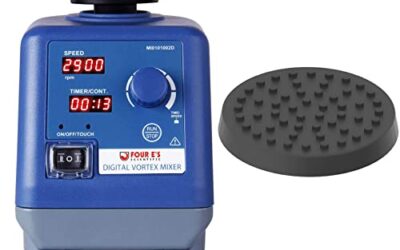
The FOUR E’S SCIENTIFIC LED Digital Vortex Mixer is the second digital pick, and it leads on orbit and on mode choice: its orbit measures 6 mm, wider than the LACHOI, and it runs in touch, timer, and continuous modes, so you can press a tube for a quick mix, set a timed run, or let it run without a timer. The LED display shows time and speed for easy reading, and the speed range runs from 0 to 3,000 rpm. The listing states that it mixes 50 ml containers within 3 seconds, which speaks to the wider orbit moving more liquid per turn. The unit runs on a 12-volt DC brushless motor, sits on an aluminum base with suction cups, and works at 50 or 60 Hz.
The wider orbit is the reason to choose this mixer over the LACHOI: a 6 mm orbit throws a larger circle than a 4.5 mm orbit, so each turn moves more liquid, which helps with thick samples and larger tubes. The suction-cup base grips the bench and keeps the unit from walking at full speed, which matters when the wider orbit adds more shake. The three modes cover the common bench patterns: touch for one tube, timer for a set run, continuous for a long mix. The LED display is smaller than the LACHOI LCD, but it still shows the two values a programmable run needs, and the 12-volt low-voltage motor is a safety plus on a crowded bench.
Two points to weigh: the listing describes the speed control as a wide 0 to 3,000 rpm range without naming fixed steps, so confirm the control layout on the listing before ordering. Stock evidence rests on a distributor listing dated four days before this guide and a mirror listing showing stock 13 days before, with no direct Amazon listing crawl surfacing in the check, so it sits behind the LACHOI on evidence and should be confirmed on the live listing before you order.
GOLICC Mini Vortex Mixer — 300-2400 RPM, Preset Speed Levels

The GOLICC is the compact pick, and it is built for a different bench problem: small bottles that need a hands-free mix. Instead of a cup head that you press a tube onto, it uses a clamp that grips bottles from 5 ml to 100 ml and holds them while the unit runs, so your hands stay free. The brushless motor reaches 2,400 rpm, and the listing describes five preset speed levels from 800 to 2,400 rpm selected with a rotary dial, plus a pulse mode for short bursts and a digital timer that switches the unit off when the set time ends. The unit measures 3.3 by 2.4 by 4 inches and weighs 1.08 pounds, which makes it the smallest and lightest mixer in this guide by a wide margin. The listing also names a 3-year warranty and UL safety certification.
The preset levels are the honest-fit note for this mixer: five levels across 800 to 2,400 rpm repeat well, because the same level gives the same speed, but they are not the same as keying in an exact rpm value, so this unit suits work where a level is enough and exact rpm is not required. The clamp is the real advantage: it holds paint, adhesive, and nail-polish bottles that a cup head cannot grip, and the hands-free run lets you prepare the next bottle while the current one mixes. The pulse mode suits short bursts, and the compact size suits a crowded bench, a hobby desk, or a bench that moves between rooms.
This is the weakest pick on stock evidence, and the guide says so plainly. The most recent Amazon listing crawl, 268 days old, shows no featured listings for this ASIN, while mirror listings dated 13 and 41 days before this guide show stock imported from the US store. That split means the unit may still be sold on Amazon US, but the evidence is thinner than for the two picks above, so check the live listing first and confirm the clamp size fits your bottles. The timer range also differs across listing copies, with one copy describing a 1 to 60 minute timer and another a 0 to 99 minute timer, so confirm the exact range before you buy. If the live listing shows no current listing for this ASIN, the LACHOI above is the safer step up.
| Mixer | Speed range | Display | Timer | Modes | Orbit | Max container | Weight |
|---|---|---|---|---|---|---|---|
| LACHOI LCD | 100-3000 rpm | LCD, speed and time | Yes, timing function | Touch, continuous | 4.5 mm | 50 ml | 6.7 lb |
| FOUR E’S SCIENTIFIC LED Digital | 0-3000 rpm | LED, speed and time | Yes, timer mode | Touch, timer, continuous | 6 mm | 50 ml | 6.7 lb |
| GOLICC Mini | 300-2400 rpm | Digital timer | Yes, auto shut-off | Preset levels, pulse | Not stated in listing | 100 ml bottles | 1.08 lb |
Frequently asked questions
What does programmable speed mean on a vortex mixer?
Programmable speed means you set a speed value and a run time, and the mixer repeats those settings. On the LACHOI and the FOUR E’S SCIENTIFIC models, the digital display shows the speed in rpm and the time, and the timer ends the run when the set time passes. On the GOLICC, the speed is set as one of five preset levels rather than an exact rpm number, and a digital timer ends the run. The key idea is repeatability: the same setting gives the same mix, so a protocol written down can be followed exactly. A dial model without a display cannot do this, because the dial position does not tell you the speed in rpm.
Is a digital vortex mixer better than a dial model?
A digital mixer is better when repeatability matters, and a dial model is fine when it does not. A dial model adjusts speed by feel, which suits a bench where one person mixes the same tubes the same way every day. A digital model shows the exact speed and time, which suits a shared bench, a written protocol, or work where the same mix must come out the same way across days and across people. Digital models also tend to include a timer, which dial models often lack. If more than one person uses the bench, or if your work follows written steps, the digital display pays for itself.
Can these mixers handle thick liquids?
Thick liquids need high speed and a wide orbit, and all three mixers here reach at least 2,400 rpm. The FOUR E’S SCIENTIFIC model pairs 3,000 rpm with a 6 mm orbit, which is the strongest combination here for thick samples. The LACHOI pairs 3,000 rpm with a 4.5 mm orbit and a 100 rpm low end, which suits both thick and delicate work. The GOLICC tops out at 2,400 rpm with preset levels, which suits thin to medium liquids in small bottles. For very thick liquids, run the mixer at its highest setting for a longer time, and check the listing for the maximum container size and load, since a tube that is too full or too heavy for the head will mix poorly at any speed.
How to choose
Match the mixer to the liquids and the bench, not to the feature list alone. If your bench mixes lab tubes up to 50 ml and needs exact, repeatable settings, take the LACHOI: its 100 rpm low end, its LCD showing speed and time, and its timing function cover the widest span of bench work, and it has the freshest stock evidence of the three. If your samples run thick and you want the widest orbit and the most modes, take the FOUR E’S SCIENTIFIC LED Digital: its 6 mm orbit and its touch, timer, and continuous modes suit heavier mixing, and its suction-cup base holds the bench at full speed. If your work is small bottles of paint, adhesive, or nail polish that need a hands-free mix, take the GOLICC: its clamp holds bottles a cup head cannot grip, and its preset levels and pulse mode suit quick blends, but confirm the live listing first, since its stock evidence is the thinnest here.
Before you order any of the three, open the listing and confirm three things: the model number matches the model in this guide, the listing states a digital display with a settable speed and a timer, and the listing shows a current listing for the exact ASIN. Makers sell look-alike variants under one brand name, and a dial variant of the same mixer will not give you the programmable control this guide is about. Check the container size against your tubes, the voltage and plug against your bench, and the base and feet against the space where the mixer will sit. A mixer that fits the bench and repeats the same run every time is the right one, and the display is what lets you know it did.
Disclosure: As an Amazon Associate, we may earn a commission from qualifying purchases made through links in this article, at no additional cost to you.