Our Short List of 3

- Best for: Mid-size greenhouses where maximum daytime airflow from a single fan is the priority.
- Solar panel: 20 watts
- Fan size: 8 inches
- Airflow: 480 CFM
- Fan speed: 2600 RPM
- Best for: Greenhouses with humid evenings, where ventilation needs to continue after sunset.
- Solar panel: 25 watts
- Fan size: 8 inches
- Airflow: 430 CFM
- Battery: 9000mAh, up to 9 hours

- Best for: Long or narrow greenhouses where two smaller fans spread air more evenly than one large exhaust point.
- Solar panel: 20 watts
- Fan type: Dual metal-shell exhaust fans
- Power source: Solar powered
- Mounting type: Window mount
All 4 Picks at a Glance
| Product | Specs | Action |
|---|---|---|
| Sun Energise Solar Powered Exhaust Fan Pro 20W |
| Check price on Amazon |
| Amaprime Solar Fan with Battery 25W 8″ |
| Check price on Amazon |
| DC HOUSE 20W Solar Powered Dual Fan Kit |
| Check price on Amazon |
 HNRLOY Solar Exhaust Fan 25W 3-Fan Kit |
| Check price on Amazon |
Key takeaways
- Compare the best greenhouse solar fans by panel wattage, airflow, battery backup and weatherproofing, with real Amazon listings for each pick.
A greenhouse without ventilation turns into an oven by mid-morning, and the real decision is not whether to add a fan but how much air it needs to move and when it needs to move it. A solar fan runs hardest exactly when the sun is strongest, which matches the heat curve of a greenhouse, but a small panel driving a small fan will barely stir the air in a large structure. The choice comes down to panel wattage, airflow, and whether the fan keeps running after the sun drops.
This guide is for greenhouse growers with small to mid-size structures, cold frames, and garden sheds that have no mains power nearby, as well as anyone ventilating a chicken coop or potting shed with sunlight alone. Every fan below is solar powered and listed on Amazon US, and every specification comes from the Amazon product page for that listing, so you can compare panel size, airflow, and battery backup on equal terms.
Quick Picks
As an Amazon Associate we earn from qualifying purchases.
| Product | Best for | Key spec from title |
|---|---|---|
| SUNYIMA Solar Panel Fan Kit 12W | Small greenhouses and cold frames | 12W panel, 200 CFM |
| Sun Energise Solar Powered Exhaust Fan Pro 20W | The strongest single-fan airflow | 20W panel, 8-inch fan, 480 CFM |
| Amaprime Solar Fan with Battery 25W 8″ | Ventilation that continues after sunset | 25W panel, 9000mAh battery |
| DC HOUSE 20W Solar Powered Dual Fan Kit | Two fans for wider coverage | 20W panel, dual metal-shell fans |
| HNRLOY Solar Exhaust Fan 25W 3-Fan Kit | Three fans for a larger structure | 25W panel, 3 fans, 3500 RPM |
How to Choose
Size the Panel to the Fan, Not the Greenhouse Alone
The solar panel is the engine, and its wattage decides how fast the fan spins. A 12-watt panel suits a small fan in a compact greenhouse, while a 20- or 25-watt panel drives a larger 8-inch fan at full speed and keeps it turning on hazy days. If the panel is too small for the fan, airflow collapses the moment a cloud passes. Read the panel wattage on the listing and treat it as the headline number: a bigger panel is the simplest way to buy steadier airflow, and it matters more than any other single specification.
Compare Airflow in Cubic Feet per Minute
Airflow, stated in CFM, is the only honest way to compare fans of different sizes. A 200 CFM kit suits a small cold frame or a hobby greenhouse, while a 430 to 480 CFM exhaust fan can exchange the air in a mid-size structure far faster. As a rough guide, a greenhouse needs its full air volume replaced every one to two minutes on a hot day, so estimate your structure’s volume and divide by the fan’s CFM before buying. If the number comes out above two minutes, step up to a larger fan or add a second kit.
Decide Whether You Need a Battery
Most solar fans in this guide run only while the sun shines, which is fine for daytime heat but leaves the greenhouse still and humid at dusk. A kit with a built-in battery keeps the fan turning for hours after sunset, which helps clear moisture and keeps air moving through the evening. Battery kits cost more and add a part that will eventually wear out, so weigh that against your climate: humid evenings and overnight condensation make a battery worth having, while a dry climate with cool nights may not need one.
Check Weatherproofing and Mounting Before Ordering
A greenhouse fan lives in heat, humidity, and occasional rain, so the weatherproof rating matters. Look for an IP44 rating or better on the fan and panel, and confirm whether the kit is meant for wall mounting, window mounting, or gable installation. Measure the opening or wall space where the fan will sit, and check the cable length between panel and fan so the panel can reach full sun while the fan sits where the hot air collects. A kit with a short cable may force a compromise on placement.
The 5 Best Options
SUNYIMA Solar Panel Fan Kit 12W
The SUNYIMA 12W kit is the simplest entry point in this guide: a weatherproof solar panel wired directly to a compact DC fan, with no battery and nothing to configure. It is designed for small and medium-sized greenhouses, sheds, and chicken coops, and it moves up to 200 CFM when the sun is strong. The panel is a modest 28 by 28 centimeters, the fan is 120 by 120 millimeters, and the whole kit carries an IP65 waterproof rating. It is the right size for a cold frame, a small hobby greenhouse, or a potting shed where a little moving air makes a big difference.
Specs
- Solar panel: 12 watts, monocrystalline silicon
- Fan size: 120 x 120 mm
- Airflow: 200 CFM
- Maximum fan speed: 3000 RPM
- Waterproof rating: IP65
- Rated voltage: 16 volts
- Panel size: 28 x 28 cm
- Cable length: 1 meter
Best for: Small greenhouses, cold frames, and sheds where a simple daytime-only fan is enough.
Watch out for: There is no built-in battery, so the fan slows or stops when sunlight weakens, and the 1-meter cable limits how far the panel can sit from the fan.
Sun Energise Solar Powered Exhaust Fan Pro 20W
- Best for: Mid-size greenhouses where maximum daytime airflow from a single fan is the priority.
- Solar panel: 20 watts
- Fan size: 8 inches
- Airflow: 480 CFM
- Fan speed: 2600 RPM
Mid-size greenhouses where maximum daytime airflow from a single fan is the priority.
Like most direct-solar fans it has no battery, so airflow stops when the sun goes down, and the 8-inch opening needs a properly sized hole in the greenhouse wall.
The Sun Energise Pro pairs a 20-watt panel with an 8-inch exhaust fan that moves up to 480 CFM in direct sunlight, the strongest single-fan airflow in this guide. It mounts on a wall or window, includes an anti-backflow valve that blocks wind and rain from entering, and runs at about 36 decibels, roughly the level of a quiet refrigerator. The dual ball bearings are rated at 67,000 hours, and the listing states the 20-watt panel keeps the fan at high speed even on cloudy days. This is the pick for a mid-size greenhouse that needs serious daytime air exchange.
Watch out for: Like most direct-solar fans it has no battery, so airflow stops when the sun goes down, and the 8-inch opening needs a properly sized hole in the greenhouse wall.
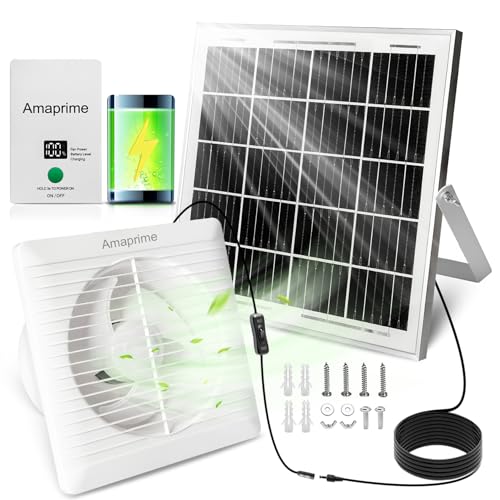
Amaprime Solar Fan with Battery 25W 8″
- Best for: Greenhouses with humid evenings, where ventilation needs to continue after sunset.
- Solar panel: 25 watts
- Fan size: 8 inches
- Airflow: 430 CFM
- Battery: 9000mAh, up to 9 hours
Greenhouses with humid evenings, where ventilation needs to continue after sunset.
The listing notes a full charge takes 4 to 6 hours, so a string of cloudy days can leave the battery short, and the battery is a wear item that will eventually need replacing.
The Amaprime kit is the only one here that keeps working after dark. A 25-watt panel charges a 9000mAh battery that runs the 8-inch fan for up to 9 hours on a full charge, with a sensor that switches between solar and battery power automatically. In sunlight it pushes up to 430 CFM at 2300 RPM, and the 16.5-foot waterproof cable gives plenty of room to place the panel in full sun. The fan is rated IP44 waterproof and runs at about 35 decibels. For a greenhouse that stays humid into the evening, the battery is the feature that matters most.
Watch out for: The listing notes a full charge takes 4 to 6 hours, so a string of cloudy days can leave the battery short, and the battery is a wear item that will eventually need replacing.
DC HOUSE 20W Solar Powered Dual Fan Kit
- Best for: Long or narrow greenhouses where two smaller fans spread air more evenly than one large exhaust point.
- Solar panel: 20 watts
- Fan type: Dual metal-shell exhaust fans
- Power source: Solar powered
- Mounting type: Window mount
Long or narrow greenhouses where two smaller fans spread air more evenly than one large exhaust point.
There is no battery, so the fans stop when sunlight fades, and the listing does not state a CFM figure, so compare it on panel wattage and fan count rather than measured airflow.
The DC HOUSE kit takes a different approach: instead of one large fan, it uses two smaller fans in metal shells driven by a single 20-watt panel. The dual layout spreads airflow across a wider area, which suits a long, narrow greenhouse better than a single point of exhaust. All accessories are treated with a waterproof layer, the fans have metal protective casings, and installation is plug and play with a waterproof connector. It is a daytime-only kit with no battery, so it runs when the sun is out and rests when it is not.
Watch out for: There is no battery, so the fans stop when sunlight fades, and the listing does not state a CFM figure, so compare it on panel wattage and fan count rather than measured airflow.
HNRLOY Solar Exhaust Fan 25W 3-Fan Kit
- Best for: Larger greenhouses or two-zone structures where three fans cover more space than a single exhaust unit.
- Solar panel: 25 watts
- Fan count: 3 ventilation fans
- Maximum speed: 3500 RPM
- Waterproof rating: IP67
Larger greenhouses or two-zone structures where three fans cover more space than a single exhaust unit.
The listing gives no CFM figure for the three fans combined, so size it by panel wattage and fan count, and confirm the mounting arrangement fits your wall or window before ordering.
The HNRLOY kit is the most ambitious in this guide: a 25-watt panel driving three ventilation fans, with a 15-foot cord and an IP67 waterproof rating. The fans spin at up to 3500 RPM, and the kit is sold for sheds, chicken coops, attics, and greenhouses, working as either intake or exhaust. Three fans give the most coverage of any kit here, which suits a larger greenhouse or a structure with two separate zones to ventilate. The listing also notes a battery is included for backup operation, so airflow does not have to stop the moment the sun dips.
Watch out for: The listing gives no CFM figure for the three fans combined, so size it by panel wattage and fan count, and confirm the mounting arrangement fits your wall or window before ordering.
Which One Fits Your Situation
You Have a Small Hobby Greenhouse
Pick the SUNYIMA 12W kit. It is sized for a compact structure, costs the least to get running, and the IP65 rating handles greenhouse humidity without worry. The 200 CFM output is enough to exchange the air in a small greenhouse regularly on a sunny day, and the simple direct-solar design means there is nothing to maintain.
Your Greenhouse Overheats by Midday
Pick the Sun Energise Pro 20W. Its 480 CFM output is the strongest single-fan airflow here, and the 20-watt panel keeps it spinning fast even when clouds pass. The anti-backflow valve keeps rain and wind out when the fan is idle, which matters on a wall-mounted exhaust that faces the weather.
Humidity Lingers After Sunset
Pick the Amaprime 25W kit with battery. The 9000mAh battery keeps air moving for up to 9 hours after dark, which is exactly when condensation forms on greenhouse walls and plants. The automatic switch between solar and battery power means you set it up once and it manages itself.
Your Greenhouse Is Long and Narrow
Pick the DC HOUSE dual-fan kit or the HNRLOY three-fan kit. A single exhaust point leaves dead air at the far end of a long structure, while two or three smaller fans spread the airflow along the whole length. Choose the DC HOUSE kit for a simple daytime setup, or the HNRLOY kit if you want three fans and the higher IP67 rating.
Common Mistakes
- Buying a fan by panel wattage alone and never checking the CFM, which is what actually moves the air.
- Sizing a fan for the greenhouse floor area instead of its volume, then finding the air exchange is far too slow on hot days.
- Mounting the solar panel in partial shade and wondering why the fan barely turns at midday.
- Choosing a daytime-only fan for a humid climate, then dealing with condensation every evening.
- Cutting a wall opening before measuring the fan, and discovering the exhaust unit does not fit the hole.
Frequently Asked Questions
How many CFM does a greenhouse fan need?
Estimate your greenhouse volume in cubic feet and divide by the fan’s CFM rating. For hot weather you want the full volume replaced every one to two minutes, so a 1,000-cubic-foot greenhouse needs roughly 500 to 1,000 CFM. Small hobby greenhouses can get by with 200 CFM, while mid-size structures need the 430 to 480 CFM class.
Do solar greenhouse fans work on cloudy days?
They work, but slower. A direct-solar fan without a battery spins in proportion to the sunlight hitting the panel, so heavy cloud can slow it to a crawl or stop it. Kits with larger panels, like the 20- and 25-watt models here, hold their speed better in haze. A battery kit keeps running regardless of cloud cover until the battery runs down.
Do I need a battery in a solar greenhouse fan?
It depends on your climate and your plants. A battery matters if evenings stay humid and condensation is a problem, since it keeps air moving after sunset for up to 9 hours on the Amaprime kit. In a dry climate where nights cool quickly, a daytime-only fan is usually enough and has one less part to wear out.
Where should I mount a solar greenhouse fan?
Mount the exhaust fan high on the wall or gable, where hot air collects, and put the solar panel where it gets direct sun for most of the day, which may not be the same spot. Check the cable length on the listing first: the kits here range from a 1-meter cable to a 16.5-foot cable, and that decides how far apart the two parts can sit.