Our Short List of 3

- Best for: A beginner who wants one handheld sprayer for walls, furniture, cabinets and fences.
- X-Boost turbine with 10 speed settings
- iSpray nozzle and Detail Finish nozzle included
- 1.5-quart cup and 32-ounce cup
- Sprays most unthinned latex

- Best for: First-time sprayers refinishing furniture, cabinets and trim on a tight budget.
- 450-watt turbine
- Three brass spray tips, 1.5 mm, 2.0 mm and 4.0 mm
- 27-ounce cup with lid
- Three spray patterns

- Best for: Bigger rooms, ceilings and whole-house projects where a hose beats carrying the turbine.
- Stationary HVLP with X-Boost turbine
- iSpray nozzle and Detail Finish nozzle included
- 11.5-foot hose
- 40-fluid-ounce cup
All 5 Picks at a Glance
| Product | Specs | Action |
|---|---|---|
| Wagner FLEXiO 590 |
| Check price on Amazon |
| HomeRight Super Finish Max |
| Check price on Amazon |
| Wagner FLEXiO 5000 |
| Check price on Amazon |
 Wagner Control Pro 130 |
| Check price on Amazon |
 Graco TrueCoat 360 VSP |
| Check price on Amazon |
Key takeaways
- Find the best paint sprayers for beginners, with simple controls, even coverage and easy cleanup for first-time painters at home, project after project.
A first paint sprayer should make painting easier, not harder. The right beginner model turns a weekend of brush strokes into a smooth coat in an afternoon, with even coverage on walls, furniture, cabinets and fences. The wrong one clogs, spits and leaves a finish that looks worse than a roller, so choosing with care matters more than choosing fast.
The five sprayers below were picked for people who have never held one before. Each one runs on household power, sets up in minutes and cleans up with a few rinsed parts. They cover the three designs a beginner meets most often, handheld HVLP, stationary HVLP and handheld airless, so you can match the machine to the size of your job.
Quick Picks
As an Amazon Associate we earn from qualifying purchases
| Product | Best for | Key spec |
|---|---|---|
| Wagner FLEXiO 590 | Versatile handheld jobs | X-Boost turbine, 10 speed settings |
| HomeRight Super Finish Max | First-time sprayers on a budget | 450-watt turbine, 3 brass tips |
| Wagner FLEXiO 5000 | Bigger rooms and whole-house jobs | Stationary HVLP, 11.5-foot hose |
| Wagner Control Pro 130 | Large exteriors with low overspray | HEA airless, 0.24 gallons per minute |
| Graco TrueCoat 360 VSP | Detail work in any direction | Variable speed, 1500 psi maximum |
How to Choose
Pick the right sprayer type
Beginners meet two main designs. HVLP sprayers move a high volume of air at low pressure, which gives a soft spray with less bounce-back mist in the room. They suit furniture, cabinets, trim and single rooms. Airless sprayers push paint through a small tip at high pressure, which covers large areas fast but throws more overspray, so they suit fences, siding and whole exteriors. A handheld HVLP is the calmest first step, while a stationary HVLP adds reach through a hose, and a handheld airless adds speed for big surfaces.
Match the sprayer to your project size
Cup size decides how often you stop to refill. A 27-ounce cup covers a chair or a cabinet door with room to spare, while a 1.5-quart cup covers a 10 by 12 foot wall in one fill. A hopper or a bucket feed suits fences and siding, where stopping every few minutes breaks your rhythm. Think about the largest job you plan this year, then pick a sprayer that handles it without constant refills, because a machine that fits a chair may frustrate you on a fence.
Check paint thickness and thinning
Thick latex paint is the most common beginner surprise. Some sprayers handle unthinned latex straight from the can, while others need a small amount of water mixed in before they spray smoothly. Check the listing for the words unthinned latex, and keep a viscosity cup or a simple stir stick nearby for a flow check. Straining paint through a mesh filter before pouring it into the cup stops dried bits from blocking the nozzle, and that one habit prevents most clogs.
Weigh cleanup and storage
Cleanup decides whether you reach for the sprayer a second time. The friendliest beginner models break into about five parts that rinse clean under a tap in roughly five minutes when the paint is water based. Airless models need a longer flush through the hose and pump, plus a storage fluid if the machine sits unused for weeks. Measure your storage shelf too, because a stationary unit with a hose and a base takes more room than a handheld gun in a carry case.
The 5 Best Options
Wagner FLEXiO 590
- Best for: A beginner who wants one handheld sprayer for walls, furniture, cabinets and fences.
- X-Boost turbine with 10 speed settings
- iSpray nozzle and Detail Finish nozzle included
- 1.5-quart cup and 32-ounce cup
- Sprays most unthinned latex
A beginner who wants one handheld sprayer for walls, furniture, cabinets and fences.
Amazon crawls showed no featured offers at the last crawl, so confirm the listing is live before ordering.
The FLEXiO 590 is the most versatile handheld sprayer in this roundup, and the easiest recommendation for a beginner who wants one machine for many jobs. Its X-Boost turbine drives paint through two included nozzles, the iSpray nozzle for broad surfaces and the Detail Finish nozzle for fine work on trim and furniture. A dial with 10 speed settings lets you slow the flow near edges and open it up on open walls, which keeps a first-timer in control.
Watch out for: Amazon crawls showed no featured offers at the last crawl, so confirm the listing is live before ordering.
HomeRight Super Finish Max
- Best for: First-time sprayers refinishing furniture, cabinets and trim on a tight budget.
- 450-watt turbine
- Three brass spray tips, 1.5 mm, 2.0 mm and 4.0 mm
- 27-ounce cup with lid
- Three spray patterns
First-time sprayers refinishing furniture, cabinets and trim on a tight budget.
Thick latex may need thinning, and the small cup means refills on bigger walls.
The Super Finish Max is the budget pick that still behaves like a proper finishing tool. Its 450-watt turbine and three brass spray tips cover latex, chalk paint and thinned enamel, which is more range than most sprayers at this size offer. The small cup and light body make it easy to hold overhead on cabinet undersides and chair rails, and the simple flow control keeps the learning curve short for a first furniture project.
Watch out for: Thick latex may need thinning, and the small cup means refills on bigger walls.
Wagner FLEXiO 5000
- Best for: Bigger rooms, ceilings and whole-house projects where a hose beats carrying the turbine.
- Stationary HVLP with X-Boost turbine
- iSpray nozzle and Detail Finish nozzle included
- 11.5-foot hose
- 40-fluid-ounce cup
Bigger rooms, ceilings and whole-house projects where a hose beats carrying the turbine.
The base unit is heavy to move between rooms, and the hose limits how far you can reach.
The FLEXiO 5000 suits beginners whose jobs run bigger than a single room. Its stationary base sits on the floor while an 11.5-foot hose feeds the spray gun, so your arm carries only the gun and cup instead of the whole turbine. The same X-Boost turbine and two-nozzle set as the handheld models spray most unthinned latex, and the larger cup keeps you moving across walls, ceilings and siding without constant stops.
Watch out for: The base unit is heavy to move between rooms, and the hose limits how far you can reach.
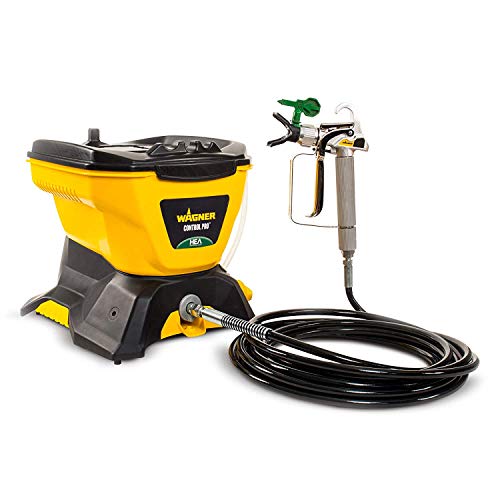
Wagner Control Pro 130
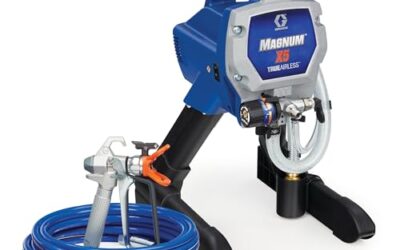
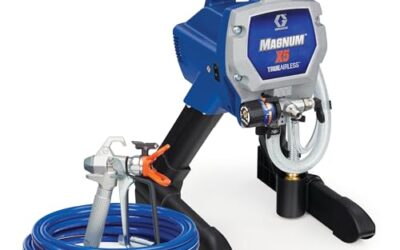
- Best for: Large exteriors, fences, decks and siding where speed matters more than fine detail.
- High Efficiency Airless with low overspray
- 0.24 gallons per minute flow
- 1.5-gallon hopper
- Sprays unthinned latex
Large exteriors, fences, decks and siding where speed matters more than fine detail.
Airless spraying needs more masking than HVLP, and it is not the pick for fine furniture detail.
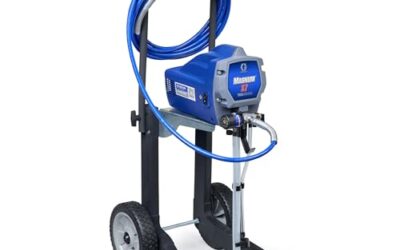
The Control Pro 130 is the beginner-friendly way into airless spraying. Its High Efficiency Airless design cuts overspray compared with older airless machines, which means less paint drifting onto floors and shrubs. A 1.5-gallon hopper feeds paint straight from the tank, so fences, decks and siding move quickly, and the 0.24 gallon per minute flow keeps up with large surfaces without the machine feeling rushed. The wheeled cart and long hose let you work along a fence line without dragging the whole unit.
Watch out for: Airless spraying needs more masking than HVLP, and it is not the pick for fine furniture detail.
Graco TrueCoat 360 VSP
- Best for: Detail work, trim, spindles and any job where you need to spray at odd angles.
- Variable speed control
- 1500 psi maximum working pressure
- 0.015-inch maximum tip size
- 4 pounds
Detail work, trim, spindles and any job where you need to spray at odd angles.
Confirm the listing is live before ordering, and FlexLiner bags are single-use.
The TrueCoat 360 VSP is the detail specialist of the group. Its variable speed control lets you slow down for spindles, trim and cabinet edges, then speed up for flat panels. The VacuValve system keeps the paint feed airtight, so you can spray in any direction, even upside down, which helps on chair undersides and ceiling corners. A stainless steel piston pump pushes unthinned paint through a reversible tip that clears clogs with a quick turn.
Watch out for: Confirm the listing is live before ordering, and FlexLiner bags are single-use.
Which One Fits Your Situation
Your first room or single wall
Pick the HomeRight Super Finish Max or the Wagner FLEXiO 590. Both are handheld, light and simple to clean, which matters when the job is one accent wall or a bedroom. The Super Finish Max costs less and handles furniture-sized work with ease, while the 590 adds speed settings and a larger cup for walls. Either one lets you learn spray technique without wrestling a hose or a cart.
Furniture and cabinet doors
Pick the HomeRight Super Finish Max first, with the Graco TrueCoat 360 VSP as the detail upgrade. The Super Finish Max lays down a smooth coat on dressers and cabinet doors, and its three brass tips cover most furniture coatings. The TrueCoat earns its place when the piece has spindles, slats or tight corners, because its variable speed and any-direction spraying reach spots a fixed gun cannot.
Fences, siding and large exteriors
Pick the Wagner Control Pro 130, with the FLEXiO 5000 as the HVLP alternative. The Control Pro 130 covers long fence runs fast from its 1.5-gallon hopper, and its low overspray design keeps paint where it belongs. The FLEXiO 5000 suits the same jobs when you prefer softer HVLP mist and a hose-fed gun, though it moves slower across very large surfaces.
Detail work and tight corners
Pick the Graco TrueCoat 360 VSP. Its variable speed dial and reversible tip give the control that fine work demands, and spraying upside down opens up chair rails, shelf undersides and ceiling edges. Keep the FLEXiO 590 nearby for the flat panels around those details, since switching between the two beats forcing one sprayer to do every job.
Common Mistakes
- Skipping masking and drop cloths, then spending longer cleaning overspray than painting
- Holding the gun too close or moving too slowly, which leaves runs and thick edges
- Pouring unstrained paint into the cup, so dried bits block the nozzle mid-coat
- Skipping a practice pass on cardboard before aiming at the real surface
- Letting paint dry inside the nozzle between coats instead of rinsing during breaks
Frequently Asked Questions
Do I need to thin paint before spraying?
It depends on the sprayer and the paint. Models that spray most unthinned latex handle standard interior latex straight from the can, while budget HVLP models often need a small amount of water for thick paint. Always strain the paint first, then run a flow check on cardboard and add water a little at a time until the spray pattern looks even.
Can a beginner sprayer handle latex paint?
Yes, every sprayer in this roundup handles latex paint, though some need thinning for the thickest formulas. Latex is the most common coating for walls, furniture and cabinets, and all five machines were chosen because their listings cover it. Water based paint also makes cleanup simple, since the parts rinse clean under a tap.
How long does cleanup take?
Handheld HVLP models clean in about five minutes when the paint is water based, since they break into a few parts that rinse under a tap. Stationary and airless models take longer because the hose and pump need flushing, and airless machines need storage fluid if they sit unused. Clean right after the last coat, before paint dries inside the gun.
HVLP or airless for a first sprayer?
HVLP is the calmer first step for most beginners, because it throws less overspray and gives a softer finish on furniture, cabinets and single rooms. Airless is the better pick when the job is a fence, siding or a whole exterior, since it covers large areas much faster. Many painters end up owning one of each as their projects grow.