Key takeaways
- Compare the best vacuum drying ovens for sample preparation by chamber size, temperature range, vacuum level, shelves and pump setup for lab drying work.
As an Amazon Associate, we earn from qualifying purchases made through links on this page.
Drying is one of the most routine steps in sample preparation, and it is also one of the easiest places to damage a sample. A standard convection oven drives off moisture with heat alone, which means heat-sensitive compounds, volatile residues and fine powders often have to survive temperatures they were never meant to see. A vacuum drying oven changes that equation. By lowering the pressure inside a sealed chamber, it lowers the boiling point of water and solvents, so samples dry faster at gentler temperatures and with far less oxidation than they would face in open air.
That makes a vacuum oven the right tool for preparing analytical samples before weighing or testing, removing residual solvent from extracts and precipitates, drying hygroscopic powders that reabsorb moisture from room air, and conditioning materials that would oxidize or degrade in a hot air oven. The four ovens below are all true vacuum drying ovens sold for laboratory work. They differ mainly in chamber size, temperature ceiling, whether a pump is included, and how much documentation and certification sits behind them, which is what should drive the choice for a sample preparation bench.
What to look for in a vacuum drying oven for sample preparation
Chamber size and shelf layout. Benchtop vacuum ovens for sample work usually fall between about 0.9 and 2 cubic feet. Match the chamber’s internal dimensions, not just the headline volume, against your largest routine load: crucibles, watch glasses, sample pans and trays all need clearance so air and vapor can move. More shelves help when you dry many small samples at once, but shelf spacing matters more than shelf count for tall containers.
Temperature range, accuracy and uniformity. Most sample drying happens well below 200 degrees Celsius, but headroom matters for stubborn solvents and for cleaning runs. Look at the controller’s stated accuracy and the uniformity figure, because a sample sitting in a cold corner of the chamber dries on a different schedule than one in the center. Multi-sided or shelf heating generally evens out the chamber better than a single heating element.
Vacuum level and how it is measured. Listings quote vacuum in different units: inches of mercury on an analog gauge, pascals, or microns for ultimate vacuum. A reading below 133 pascals and an ultimate vacuum in the hundreds of microns both describe a deep vacuum suitable for drying. What matters for repeatable sample prep is that the oven holds its vacuum over a long dwell without creeping back up, which depends on the door gasket, valves and tubing as much as on the pump.
The pump situation. Some ovens ship with a matched vacuum pump; many do not. If the pump is sold separately, budget for a rotary vane pump with enough flow for the chamber volume and check the connection standard, most often a KF25 flange on lab ovens. An oven with no pump included is not a problem if your lab already owns a suitable pump, but it is the most common surprise purchase in this category.
Certification and build. For labs that answer to safety officers or auditors, a recognized listing such as UL, CSA or ETL on the exact model is worth confirming before purchase. Stainless steel chambers clean more easily and resist solvent attack better than coated interiors, and a dual-layer tempered glass window lets you watch a sample without breaking vacuum.
The best vacuum drying ovens for sample preparation
Across International AccuTemp AT19P7 1.9 Cu Ft Vacuum Oven with 7 CFM Pump

ASIN: B00JXW0YA2
The AT19P7 is the most complete package in this group because Across International bundles the oven with its EasyVac 7 CFM vacuum pump, so the chamber, pump and fittings arrive as a matched set. The 1.9 cubic foot stainless steel chamber is the largest benchtop size here, and five-sided pad heating wraps the chamber walls to keep shelf temperatures even across a full load of sample pans. An oil-filled mechanical gauge reads from 0 to 30 inches of mercury, and the stainless tubing and valves are built to hold vacuum over long dwell cycles rather than leak down between checks.
- Capacity: 1.9 cu ft; chamber 16.5 x 14.5 x 14 inches, stainless steel
- Temperature range: ambient to 480°F (250°C), controller accuracy plus or minus 1°F
- Heating: 5-sided pad heating
- Vacuum gauge: oil-filled mechanical gauge, 0 to 30 inHg
- Ultimate vacuum: better than 500 microns with a suitable pump
- Vacuum port: KF25 flange
- Shelves: 5 aluminum slide-in shelves, 16 x 14.25 inches each
- Pump: EasyVac 7 CFM vacuum pump included
- Electrical: 110V, 60Hz, 1,500W
- Weight: about 140 lb for the oven
Who it is for: Labs that dry larger or more frequent sample batches and want the pump question settled in the same purchase, with room to spread samples across five shelves instead of stacking them.
Limitations: At roughly 140 pounds and with a footprint to match, this is a fixed bench installation rather than something you move between rooms. The bundled pump solves compatibility, but labs that already own a suitable pump are paying for a second one.
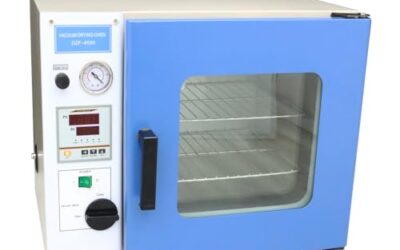
HayWHNKN 0.9 Cu Ft Digital Vacuum Drying Oven, 1KW

ASIN: B08G1BNGYL
This 0.9 cubic foot oven covers the core sample preparation job in a smaller footprint: a digital PID controller, a stated vacuum degree below 133 pascals, and a wide temperature range that reaches 250 degrees Celsius for stubborn residues. The listing is aimed at laboratories in enterprises, schools and research institutes, and the control set is deliberately simple: set the temperature, set the dwell timer anywhere from 1 to 9,999 minutes, and let the controller hold the setpoint within a stated plus or minus 1 degree Celsius.
- Capacity: 0.9 cu ft; chamber about 12 x 11 x 11 inches
- Temperature range: 50 to 250°C (122 to 482°F)
- Temperature fluctuation: plus or minus 1°C, PID control
- Vacuum degree: below 133 Pa as stated in the listing
- Timer: 1 to 9,999 minutes
- Shelves: 2
- Electrical: 110V, 60Hz, 1,000W
- Pump: not included; the listing specifies a matching pump rate of 1 L/s
Who it is for: Small labs and teaching labs that need a straightforward vacuum oven for routine moisture and solvent removal, and that already own, or are happy to choose, a separate pump.
Limitations: The pump is a separate purchase, and the listing does not name a third-party safety certification, which can matter for institutional purchasing. Documentation and long-term parts support are thinner than with the established laboratory brands.
HayWHNKN 0.9 Cu Ft Vacuum Drying Oven, 600W

ASIN: B0CX8NSJCV
The second HayWHNKN model trades heating power and top temperature for a 304 stainless steel chamber and gentler running. Its 600W draw is the lowest in this group, and the listed ceiling of 200 degrees Celsius still covers the great majority of sample drying protocols, which typically run between 40 and 120 degrees under vacuum. The chamber is a near-cube at 300 x 300 x 275 millimeters, which suits squat sample containers and stacked petri dishes better than a shallow, wide chamber does.
- Capacity: 0.9 cu ft
- Chamber: 300 x 300 x 275 mm, 304 stainless steel
- Temperature range: 50 to 200°C
- Temperature fluctuation: plus or minus 1°C
- Vacuum degree: below 133 Pa as stated in the listing
- Timer: 1 to 9,999 minutes
- Shelves: 2
- Electrical: 110V, 600W
- Pump: not included; the listing specifies a matching pump rate of 1 L/s
Who it is for: Labs drying heat-sensitive samples at moderate temperatures that want a stainless chamber and a lower power draw, for example on a shared bench circuit.
Limitations: The 200 degree ceiling rules out high-temperature cleaning or conditioning runs, and as with its sibling model the pump must be sourced separately and no third-party certification is stated in the listing.
BVV Neocision 7.5CF Vacuum Oven with 9CFM Two Stage Pump Kit

ASIN: B09HV6Q7MQ
The Neocision 7.5CF sits at the opposite end of the scale from the benchtop models. Its 7.5 cubic foot chamber uses five individually heated shelves, so each shelf holds its own setpoint behavior instead of relying on chamber air, and this kit version pairs the oven with a 9 CFM two-stage vacuum pump rather than leaving the pump to the buyer. The Neocision line is ETL certified to ANSI/UL 61010-1 and 61010-2-010 and to CAN/CSA C22.2 standards, which is the kind of documentation a compliance review asks for by name.
- Capacity: 7.5 cu ft
- Model: 75NEOV9D
- Heating: 5 individually heated shelves
- Certification: ETL, conforming to ANSI/UL STD. 61010-1 and 61010-2-010; certified to CAN/CSA STD. C22.2 NO. 61010-1 and 61010-2-010
- Pump: 9 CFM two-stage vacuum pump kit included
- Vacuum connection: KF25
- Delivery: freight item
Who it is for: Production and quality-control labs that prepare samples in tray after tray, and facilities whose purchasing process requires a named safety certification on the oven.
Limitations: This is a floor-standing freight shipment, not a benchtop appliance, so it needs floor space, a receiving plan and a permanent home. For a single analyst drying a few crucibles at a time, the capacity is far beyond the workload, and the Neocision series temperature ceiling is modest next to the 250 degree models above.
Comparison table
| Model | Capacity | Temperature range | Stated vacuum | Shelves | Pump included |
|---|---|---|---|---|---|
| Across International AccuTemp AT19P7 | 1.9 cu ft | Ambient to 480°F (250°C) | Better than 500 microns | 5 | Yes, 7 CFM |
| HayWHNKN 0.9 Cu Ft 1KW | 0.9 cu ft | 50 to 250°C | Below 133 Pa | 2 | No |
| HayWHNKN 0.9 Cu Ft 600W | 0.9 cu ft | 50 to 200°C | Below 133 Pa | 2 | No |
| BVV Neocision 7.5CF Kit | 7.5 cu ft | Series range up to 212°F | Below 500 microns | 5 heated | Yes, 9 CFM two-stage |
Frequently asked questions
Does a vacuum drying oven come with a vacuum pump?
Sometimes, and it is one of the first things to check on any listing. Two of the ovens above, the Across International AT19P7 and the BVV Neocision kit, include a matched pump. The two HayWHNKN models do not, so a rotary vane pump of suitable flow has to be bought separately and connected, usually through a KF25 flange.
What vacuum level do I need for sample preparation?
For drying, the practical target is a stable vacuum that stays put for the whole dwell, rather than the deepest number on a spec sheet. Listings express this differently: below 133 pascals, or an ultimate vacuum in the hundreds of microns, both describe vacuum deep enough to drop the boiling point of water and common solvents substantially. A gauge that reads in inches of mercury is fine for routine work; micron-level readings matter when you are verifying ultimate vacuum or leak-checking the chamber.
Why dry samples under vacuum instead of in a regular oven?
Lower pressure lowers the boiling point of liquids, so moisture and solvent leave the sample at lower temperatures. That protects heat-sensitive compounds, reduces oxidation because there is less air in the chamber, and shortens drying time for many materials. It is the standard approach when the sample’s composition, not just its dryness, has to survive preparation unchanged.
Can a vacuum drying oven replace a desiccator?
They solve overlapping problems at different speeds. A desiccator stores already-dry samples and slowly equilibrates small items at room temperature, while a vacuum oven actively dries samples with heat and vacuum on a schedule. Most sample preparation benches use both: the oven to dry, the desiccator to hold samples between drying and weighing.
How do I choose between 0.9 and 1.9 cubic feet?
Measure your largest normal load, including the containers, and compare it with the chamber’s internal dimensions rather than the headline volume. A 0.9 cubic foot oven handles crucibles, dishes and small trays for one analyst comfortably. Step up to 1.9 cubic feet when several people share the oven or when batches regularly fill more than two shelves.
Conclusion
For most sample preparation benches, the deciding factors are chamber fit, a temperature range that covers your protocols with headroom, and whether the pump is in the box. The Across International AT19P7 is the easiest recommendation here because the 1.9 cubic foot chamber, five-sided heating and included 7 CFM pump arrive as one matched, well-documented package. The two HayWHNKN 0.9 cubic foot models cover smaller benches and gentler budgets of bench space and power, provided you plan for a separate pump. And for facilities drying at production scale or buying against a certification requirement, the BVV Neocision 7.5CF kit is the purpose-built option. Whichever size you choose, confirm the pump connection and the chamber’s internal dimensions against your actual sample containers before ordering.