Our Short List of 3
- Best for: pilot-scale formulation and thick samples that need a stored speed and a timed run.
- Power: 850W
- Speed range: 1000-28000 rpm, stepless
- Operating head: 316 stainless steel, 36G
- Processing volume: 150-13000 ml

- Best for: shared bench labs running varied emulsions and dispersions every day.
- Power: 500W
- Speed range: 2000-28000 rpm, adjustable
- Display: digital display showing speed, torque, and time
- Working head: adjustable position, easy-to-clean structure

- Best for: small samples, teaching labs, and first-time buyers who need a complete kit.
- Power: 185W
- Speed range: 8000-22000 rpm
- Display: digital display
- Speed control: knob, infinitely adjustable
All 3 Picks at a Glance
| Product | Specs | Action |
|---|---|---|
| MXBAOHENG High Shear Mixer Emulsifier |
| Check price on Amazon |
| LSBHPPD 500W Laboratory Dispersing Homogenizer |
| Check price on Amazon |
| BIXIBIN 185W High-Speed Homogenizer |
| Check price on Amazon |
Key takeaways
- Compare 4 lab homogenizers with programmable speed, timers, and digital displays. Find the right rotor-stator unit for tissue and emulsion work.
Buying a laboratory homogenizer with programmable speed is really a decision about repeatability. When a protocol calls for a set speed and a set run time, a unit that holds those settings run after run removes one variable from every batch. A dial you twist by feel cannot do that, and a unit that drifts as the sample thickens cannot do it either. The practical choice is between a basic digital unit that shows the speed, a mid-range unit that adds a timer and speed memory, and a heavy-duty unit built for large volumes and thick samples.
This guide is for bench scientists, formulation chemists, food and cosmetics developers, and teaching-lab managers who need the same result from the same settings every time. Each product below was chosen from its Amazon listing title and specifications, focusing on digital speed control, timer functions, speed memory, and the volume and viscosity range each unit is built to handle.
Quick Picks
As an Amazon Associate we earn from qualifying purchases.
| Product | Best for | Key spec from title |
|---|---|---|
| MXBAOHENG High Shear Mixer Emulsifier | Large batches and thick samples | 850W, 1000-28000 rpm, timer and speed memory |
| ylpddmm High Speed Dispersing Homogenizer | Timed runs with live torque feedback | LCD display with timer, 2000-28000 rpm |
| LSBHPPD 500W Laboratory Dispersing Homogenizer | Everyday emulsions and dispersions | 500W, 2000-28000 rpm, digital display |
| BIXIBIN 185W High-Speed Homogenizer | Small samples and teaching labs | 185W, 8000-22000 rpm, 2 working heads |
How to Choose
Speed control that holds its setting
Programmable speed means the unit accepts a numeric speed and stays there. Look for a digital display that shows actual speed in real time, plus a memory function that recalls the last setting when the unit is switched back on. Stepless adjustment matters because protocols often land between round numbers, such as 12,500 rpm rather than 10,000 or 15,000. A unit with automatic speed compensation is worth more than a wider headline range, since thick samples drag a weak motor down and change the shear the sample actually receives. Ask whether the display shows set speed, actual speed, or both.
Timer and run modes
A built-in timer turns a homogenizer from a hand tool into a protocol instrument. Timed runs let two operators produce the same emulsion, and a unit that stops itself at the end of the set time prevents over-processing delicate samples. Some units provide continuous operation alongside a timer that runs to 6,000 minutes, which covers both quick dispersions and long emulsification cycles. Check the maximum continuous run time as well, because several compact units are rated for only a few minutes of continuous work before a rest period is required.
Volume range and working heads
Match the working head to the smallest and largest volumes the lab actually runs. A 12 mm head suits small tubes and beakers, while an 18 mm or 36 mm head moves larger volumes faster and handles thicker material. Units that ship with two heads cover a wider range without a second purchase, and a head that adjusts in height lets the operator set immersion depth for different vessels. A unit rated for 5 to 1,000 ml fits most bench work, while one rated to 13 litres belongs in pilot-scale formulation rather than on a crowded bench.
Viscosity, power, and duty cycle
Power and viscosity limits decide whether a homogenizer finishes a batch or stalls halfway through. A 185W unit handles watery samples and light emulsions, a 500W unit covers most cosmetic and food dispersions, and an 850W unit is built for samples up to 7,000 mPa.s. Duty cycle is the quiet constraint: compact units often need a pause after a few minutes, while heavier units run longer without overheating. Overload protection and temperature monitoring protect the motor when a sample thickens unexpectedly, and a gentle ramp-up reduces splashing when the head enters a full vessel.
The 4 Best Options
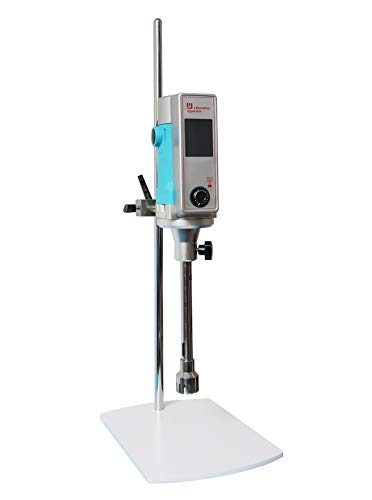
MXBAOHENG High Shear Mixer Emulsifier
- Best for: pilot-scale formulation and thick samples that need a stored speed and a timed run.
- Power: 850W
- Speed range: 1000-28000 rpm, stepless
- Operating head: 316 stainless steel, 36G
- Processing volume: 150-13000 ml
pilot-scale formulation and thick samples that need a stored speed and a timed run.
the unit is a full-size bench machine, so confirm bench space, head clearance, and vessel height before ordering.
The MXBAOHENG is the most protocol-oriented unit in this group, and it suits labs that run the same formulation repeatedly at scale. Its timer and speed memory let an operator store a working speed and recall it for the next batch, which is exactly what a standard operating procedure needs. The wide volume range covers everything from a 150 ml test batch to a 13-litre pilot run, and the high-torque motor holds speed as viscosity climbs. It is a large, heavy bench unit, so it fits a dedicated formulation station better than a shared bench that gets rearranged daily.
Watch out for: the unit is a full-size bench machine, so confirm bench space, head clearance, and vessel height before ordering.
ylpddmm High Speed Dispersing Homogenizer
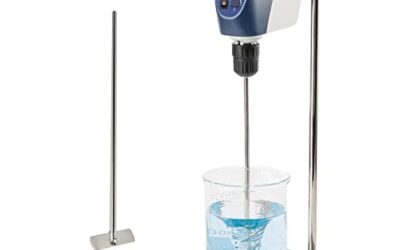
The ylpddmm unit is built around live feedback, showing speed, torque, and timer data on its LCD at the same time. That combination helps when a formulation changes viscosity mid-run, because the operator can see the load rising and adjust before the emulsion breaks or the motor strains. Automatic speed compensation works toward the same goal, topping the speed back up to the set value as the sample thickens. The 304 stainless shearing head and support stand make it a complete bench setup for cosmetics, food, coatings, and daily-chemical development work.
Specs
- Speed range: 2000-28000 rpm, stepless
- Display: LCD showing real-time speed, torque, and timer
- Timer function included
- Working head: 304 stainless steel shearing head
- Motor: DC motor with automatic speed compensation
- Support stand included
- Working head size: 18G
Best for: formulation runs where watching torque and time matters as much as setting speed.
Watch out for: the listing gives a single 18G head, so check that head size against the smallest vessels used in the lab.
LSBHPPD 500W Laboratory Dispersing Homogenizer
- Best for: shared bench labs running varied emulsions and dispersions every day.
- Power: 500W
- Speed range: 2000-28000 rpm, adjustable
- Display: digital display showing speed, torque, and time
- Working head: adjustable position, easy-to-clean structure
shared bench labs running varied emulsions and dispersions every day.
confirm the included working head diameter against the narrowest tubes the lab uses, since head size limits minimum vessel width.
The LSBHPPD is the middle-ground choice for labs that need real digital control without stepping up to a pilot-scale machine. Its 500W motor and 2000 to 28000 rpm range cover the emulsions, dispersions, and tissue work most bench labs run daily, and the digital display reports speed, torque, and time as the run progresses. The same automatic speed compensation found on larger units keeps the set speed steady when a sample thickens, and the adjustable head position adapts to different vessel heights. It is a sensible pick for a shared lab where several people run different samples on the same machine.
Watch out for: confirm the included working head diameter against the narrowest tubes the lab uses, since head size limits minimum vessel width.
BIXIBIN 185W High-Speed Homogenizer
- Best for: small samples, teaching labs, and first-time buyers who need a complete kit.
- Power: 185W
- Speed range: 8000-22000 rpm
- Display: digital display
- Speed control: knob, infinitely adjustable
small samples, teaching labs, and first-time buyers who need a complete kit.
continuous runs are limited to 3 minutes, so plan pauses into any protocol that needs longer processing.
The BIXIBIN is the compact option, built for small volumes and labs where bench space and budget are tight. It ships with two working heads and four measuring cups, so a teaching lab or a small research group can begin work without buying accessories separately. The digital display shows the set speed while a knob adjusts it across the 8000 to 22000 rpm range, and the 12 mm head reaches into small beakers that larger units cannot use. Its 5 to 1000 ml range covers tissue samples, small emulsions, and classroom demonstrations, though the short continuous working time means long runs need pauses.
Watch out for: continuous runs are limited to 3 minutes, so plan pauses into any protocol that needs longer processing.
Which One Fits Your Situation
Running the same formulation every week
Pick the MXBAOHENG. Its speed memory and timer let the operator recall the exact settings from the last batch, and the high-torque motor holds those settings through thick samples. The large volume range also means a test batch and a pilot batch can run on the same machine with the same protocol.
Developing emulsions that change as they mix
Pick the ylpddmm unit. The live torque readout shows when a sample thickens or thins during the run, and automatic speed compensation keeps the shear steady. The timer stops the run at the set point, so a formulation is not over-processed while the operator watches something else, and the recorded speed and time make the result easier to repeat next time.
Equipping a shared bench for varied daily work
Pick the LSBHPPD. Its 500W motor and wide speed range handle most routine emulsions and dispersions, and the digital display gives every operator the same speed, torque, and time information. The adjustable head adapts to the different vessels a shared lab accumulates over time, and the automatic speed compensation keeps results consistent when operators change samples mid-day.
Working with small samples on a tight budget
Pick the BIXIBIN. Two working heads and four measuring cups cover small-volume work out of the box, and the 12 mm head fits narrow vessels that larger units cannot enter. Keep runs short and allow cooling pauses, since the 3-minute continuous limit shapes how protocols should be written for this unit, and reserve it for light samples rather than thick pastes.
Common Mistakes
- Choosing a unit by its top speed alone instead of checking whether it holds that speed under load.
- Buying a single large working head and then finding it does not fit the narrowest tubes in the lab.
- Ignoring the continuous run limit and overheating a compact unit on a long emulsification cycle.
- Skipping the timer and speed memory, then discovering that two operators produce different batches from the same protocol.
- Ordering a unit without confirming the plug and voltage match the lab supply, especially on listings that show both 110V and 220V variants.
Frequently Asked Questions
What does programmable speed mean on a laboratory homogenizer?
It means the operator sets a numeric speed on a digital control and the unit holds it, often with a timer and a memory function that recalls the setting. That is different from a simple dial, where the speed depends on knob position and can drift as the sample thickens. Units with automatic speed compensation come closest to true programmable behaviour at bench-lab prices.
How much volume can these homogenizers handle?
It depends on the model. The compact BIXIBIN covers 5 to 1000 ml, the LSBHPPD and ylpddmm units sit in the mid-range for bench batches, and the MXBAOHENG reaches 150 ml up to 13 litres for pilot-scale work. Always match the working head diameter to the vessel as well, since a wide head cannot enter a narrow tube.
Can a homogenizer with a timer run continuously?
Most timer-equipped units provide both timed and continuous modes, but continuous running has limits. Compact models may need a rest after a few minutes, while heavier bench units run far longer. Check the listed continuous working time and duty cycle before writing a protocol that assumes an hour-long uninterrupted run.
Which working head size should a lab choose first?
Begin with the smallest head that covers the most common vessel. A 12 mm head fits small beakers and tubes, while an 18 mm or 36 mm head moves larger volumes faster. Labs that run both small and large batches should favour a unit that ships with two heads, or budget for a second head before the first project begins.